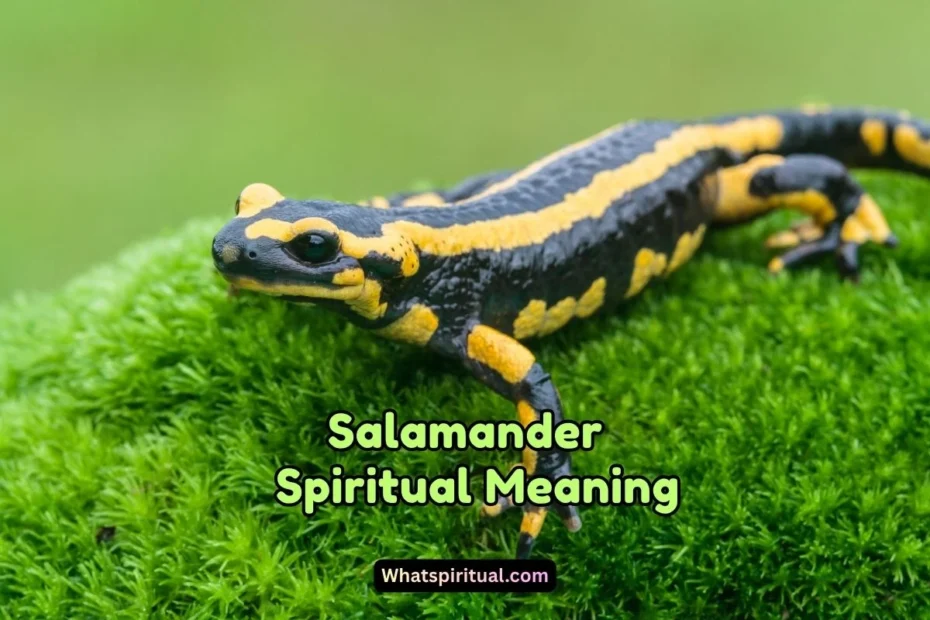
You have probably never thought much about a salamander. It moves quietly, hides in damp corners, and rarely demands attention. Yet in nearly every ancient spiritual tradition, the salamander holds a place of profound mystery and power. Salamander spiritual meaning stretches across fire mythology, alchemical wisdom, emotional depth, and transformative energy in ways that few creatures can match.
When a salamander appears in your life, whether physically, in a dream, or as a recurring symbol, it is rarely a coincidence. Spiritual traditions from ancient Rome and Greece to Native American teachings and medieval European alchemy all recognized the salamander as a carrier of sacred energy. These traditions did not agree on everything, but they agreed on this: the salamander is not an ordinary creature.
This blog post pulls together everything you need to know about salamander symbolism, its spiritual meanings across cultures, its role as a spirit and totem animal, and what it might mean when one shows up in your dreams or waking life. Whether you are drawn to this creature for personal reasons or simply curious about its rich symbolic history, you are about to see the salamander in a completely different light.
Key Takeaways
- The salamander is a powerful symbol of fire, transformation, and emotional resilience across multiple spiritual traditions.
- In alchemy and medieval mysticism, the salamander was believed to live within fire itself, making it a symbol of purification and spiritual endurance.
- Salamander spirit animal energy calls you toward inner renewal, emotional healing, and embracing change without losing your core identity.
- Across Native American, Celtic, and Eastern spiritual traditions, the salamander represents adaptability, hidden wisdom, and the balance between elements.
- Dreaming of a salamander often signals a period of personal transformation, a need for emotional cleansing, or a call to trust your intuition.
What Is a Salamander?
The salamander is a small, slender amphibian belonging to the order Urodela. It lives across North America, Europe, Asia, and parts of North Africa. Salamanders thrive in moist, wooded environments. They are known for their smooth, moist skin and their remarkable ability to regenerate lost limbs, a biological trait that has made them symbols of renewal and healing for thousands of years.
There are over 700 known species of salamanders. Some are entirely aquatic, others are fully terrestrial, and many move between both worlds. This dual nature, living comfortably between water and land, water and fire in mythology, gives the salamander its powerful symbolic position as a creature of transitions and thresholds.
Historically, people confused the salamander with lizards and mythical fire creatures. Ancient observers noted that salamanders often crawled out from beneath logs thrown into fires, creating the legend that they were born from flames or immune to burning. This single observation sparked centuries of fire-related spiritual symbolism and became the foundation of one of the most enduring mythological narratives in Western mysticism.
The salamander’s cold, moist skin was also believed in folk medicine to extinguish fire upon contact. This paradox of a cold-blooded creature associated with fire made it a perfect symbol for alchemists studying the tension between opposites: hot and cold, transformation and preservation, destruction and renewal.
What Does Seeing a Salamander Symbolize?
Seeing a salamander in your daily life is rarely just a natural encounter. Many spiritual practitioners and animal symbolism traditions view animal sightings as messages from the universe, ancestors, or the deeper self. A salamander sighting carries a specific set of messages depending on the context in which it appears.
When you see a salamander near water, it often symbolizes emotional clarity and the need to trust your feelings. Water represents the subconscious mind in many spiritual frameworks. A salamander at the water’s edge suggests you are standing at the boundary between what you know and what you are yet to understand about yourself.
Spotting a salamander on dry land or near fire carries a different energy. It speaks to resilience under pressure. You may be going through a trial, a difficult season of life, or a situation that feels like it is burning everything down. The salamander’s appearance in this context is a spiritual reminder that fire does not have to destroy you. You can pass through it and come out renewed.
A salamander crossing your path is widely interpreted as a sign that change is imminent. This change may feel uncomfortable at first. But the salamander does not resist its own transformation. It regenerates. It adapts. The message is clear: you have the inner resources to regenerate too.
Seeing a dead salamander can be unsettling, but spiritually it often signals the end of one phase and the beginning of another. It is the completion of a cycle rather than a simple loss. Something in your life may be closing so that something new can enter.
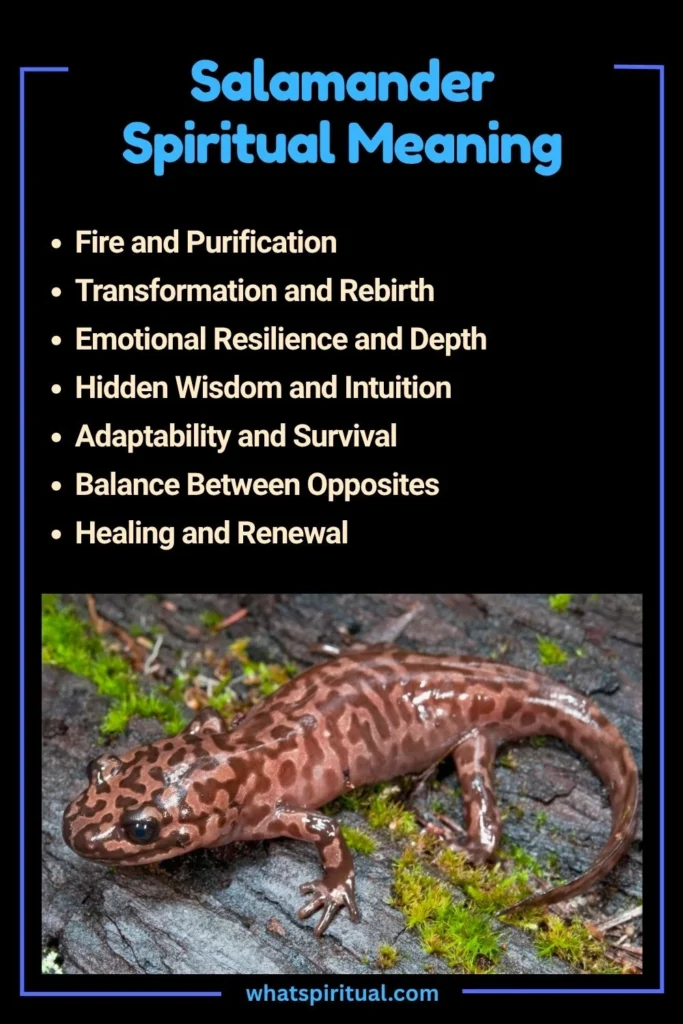
7 Spiritual Meanings of Salamander
1. Fire and Purification
The most ancient and enduring spiritual meaning of the salamander is its connection to fire. Greek philosopher Aristotle wrote about the salamander’s legendary immunity to flames. Medieval alchemists took this concept further, treating the salamander as the elemental spirit of fire itself. In their framework, fire was not just a physical element. It was the agent of spiritual purification and transformation.
When the salamander represents fire in a spiritual context, it is speaking about the purifying power of difficulty. Fire burns away what is no longer useful. It strips away the false to reveal the true. The salamander as fire symbol is a reminder that your hardest experiences are not punishments. They are processes of spiritual refinement.
Ancient Persian Zoroastrian texts also honored fire as sacred and saw creatures associated with fire as spiritual messengers. The salamander’s legendary fire connection placed it within a broader framework of divine purification across ancient civilizations. These traditions teach that passing through fire, whether literal or metaphorical, is how the soul becomes more genuinely itself.
In your own life, the salamander’s fire symbolism may be most relevant during seasons of intense challenge or grief. When you feel like you are burning, the salamander whispers a truth: the flame is not your enemy. It is the very thing transforming you into who you are meant to be.
2. Transformation and Rebirth
Few creatures in the natural world carry the transformative symbolism that the salamander does. Its ability to regenerate entire limbs is biologically extraordinary. A salamander can lose a leg, a tail, or even parts of its heart tissue, and grow them back completely. This physical reality became the foundation for its deep association with spiritual rebirth and regeneration.
Carl Jung, the foundational psychologist and mythologist, referenced the salamander in his writings on alchemical symbolism. He saw it as an archetype of transformation, the part of the psyche that survives every death and reconstruction of the self. The salamander does not merely survive loss. It becomes whole again. This is the transformative promise it carries.
In spiritual traditions that honor cyclical time, including many Indigenous and Eastern frameworks, the salamander represents the wisdom of becoming. Nothing is permanently lost. Everything that falls away creates space for something more authentic to emerge. The salamander’s rebirth is not accidental. It is a disciplined biological intention, and that mirrors what conscious spiritual transformation requires of a person.
When the salamander appears as a symbol of transformation in your life, it is asking you to trust the process of becoming. You may not recognize yourself right now. You may feel like pieces of who you were are falling away. The salamander says that is exactly what growth looks like. Keep going.
3. Emotional Resilience and Depth
The salamander lives between two worlds: water and land. In spiritual symbolism, water governs the emotional and subconscious realm, while land represents the conscious, practical world. The salamander’s ability to exist in both speaks to a profound emotional intelligence and resilience.
Emotionally resilient people, like the salamander, do not deny or suppress their feelings. They move through emotional landscapes with honesty and then return to solid ground. The salamander symbolizes the capacity to feel deeply without being swept away. It models the emotional balance that so many spiritual traditions describe as inner maturity.
In Celtic traditions, bodies of water were considered portals to the spirit world. Creatures that bridged water and land, like the salamander, were thought to carry messages from the ancestors or from deeper spiritual dimensions. The salamander’s emotional symbolism in this context carries an added layer: it is not just emotionally resilient. It is emotionally wise because it has access to hidden spiritual knowledge.
If the salamander is appearing as an emotional symbol for you, it may be time to stop avoiding the depths. Your feelings are not your enemy. They are your most honest navigational system. The salamander teaches you to go into the water, feel what is there, and come back to land carrying wisdom you could not have found any other way.
4. Hidden Wisdom and Intuition
Salamanders are secretive by nature. They move at night, hide beneath rocks and leaves, and avoid direct light. This behavior has made them consistent symbols of hidden wisdom, intuition, and the power of what is not immediately visible. In many spiritual traditions, the most important truths are the ones that require patience and stillness to find.
The salamander invites you to trust what you cannot yet fully see. Intuition is not irrational. It is the synthesis of deep pattern recognition and subconscious awareness. People who dismiss intuition often do so because it does not show up loudly or obviously. The salamander’s medicine is precisely this: truth does not always announce itself. Sometimes it lives quietly under the surface, waiting for you to be still enough to notice it.
In Hermetic and alchemical philosophy, the salamander as elemental fire spirit was also a guardian of hidden knowledge. Alchemists believed the fire element held the secrets of transformation, and the salamander was the living key to those secrets. Accessing this wisdom required patience, practice, and a willingness to sit with mystery before demanding clarity.
If the salamander is your symbol right now, pause before rushing to conclusions. Slow your decisions. Let your instincts speak. The salamander’s hidden wisdom tradition encourages you to become comfortable with not knowing because certainty often comes to those who stop forcing it.
5. Adaptability and Survival
One of the most striking realities about salamanders is their extraordinary adaptability. They survive in environments ranging from arid deserts to frigid mountain streams to dense tropical forests. Some species can enter states of torpor during dry seasons and revive completely when moisture returns. This biological flexibility mirrors a profound spiritual quality: the ability to survive and thrive across radically different conditions.
Spiritual traditions often associate adaptability with wisdom rather than weakness. The willow that bends in the storm survives where the rigid oak breaks. The salamander carries this same message. Spiritual flexibility is not the same as spiritual compromise. Adapting to your circumstances does not mean abandoning your values. It means knowing how to carry your truth through every kind of terrain.
Native American traditions that recognize the salamander often situate it within teachings about survival through change. Life does not hold still. Seasons shift, relationships evolve, and the self grows in ways that can feel disorienting. The salamander’s adaptability teaches that your core identity is not threatened by change. You can change your environment, your approach, even your understanding, and still remain fundamentally yourself.
This meaning is especially relevant during major life transitions: job loss, the end of a relationship, geographical relocation, or any significant shift in your sense of identity. The salamander says you are built for this. Your capacity to adapt is not a compromise. It is one of your greatest spiritual strengths.
6. Balance Between Opposites
The salamander occupies a uniquely paradoxical position in spiritual history. It is cold-blooded yet associated with fire. It lives in water yet represents the fire element. It is small and unassuming yet carries enormous symbolic weight. This position as a creature of contradictions makes it one of the most powerful symbols of balance between opposites.
In Taoist philosophy, the tension between opposites, yin and yang, is not a problem to be solved. It is the dynamic engine of all reality. The salamander embodies this teaching physically. Its body is cold and moist, yet tradition placed it at the center of flame. This contradiction is not a mistake. It is the whole point. True wisdom contains contradictions.
Medieval European spiritual thinkers wrote about the salamander as proof that the natural world contains mysteries that defy simple categories. The creature defied ordinary logic. You could not simply place it in one box and move on. It demanded complexity of thinking, and in doing so, it modeled the kind of nuanced wisdom that mature spiritual life requires.
When the salamander shows up as a symbol of balance, it may be asking you to stop insisting on simple answers. Your life, your personality, and your spiritual path may contain tensions that cannot be resolved neatly. The salamander invites you to hold those tensions with grace rather than forcing premature resolution.
7. Healing and Renewal
The salamander’s capacity for physical regeneration made it one of the most important healing symbols in ancient natural philosophy. Pliny the Elder, the Roman naturalist, wrote extensively about the salamander’s supposed healing properties. Medieval herbalists and apothecaries attributed almost magical medicinal qualities to salamander-related preparations, even though many of these beliefs were rooted more in symbolism than in actual chemistry.
But the spiritual truth behind these beliefs is sound. The salamander represents the body’s and soul’s innate capacity for healing. Modern science has confirmed what ancient observers intuited: the salamander’s regenerative biology is genuinely extraordinary. It can regrow entire limbs with perfectly functional nerves, muscles, and blood vessels. This is not metaphor. It is physical fact, and it amplifies the spiritual meaning enormously.
In shamanic healing traditions, animals associated with regeneration are called upon during healing ceremonies. They are seen as carriers of vital, restorative energy that can be channeled toward the sick or wounded, whether physically, emotionally, or spiritually. The salamander’s regenerative symbolism places it naturally within these healing frameworks.
If you are in a season of recovery, whether from illness, heartbreak, trauma, or spiritual drought, the salamander is one of your most powerful symbols. It carries the message that you are not permanently damaged. What has been lost can be rebuilt. What has been broken can become whole again. Healing is not just possible. According to the salamander’s ancient wisdom, healing is your natural state.
Salamander Meaning and Significance Across Cultures and Religions
Ancient Greece and Rome
Greek and Roman naturalists were among the first to document the legendary fire-resistance of the salamander. Aristotle wrote that the salamander “not only walks through fire without being hurt, but actually puts it out in doing so.” This belief was widely accepted in classical antiquity. It shaped the salamander’s reputation as a symbol of invulnerability and purifying power.
Roman soldiers reportedly wore salamander symbols for protection, believing the creature’s fire-immune nature would shield them in battle. The salamander became a symbol of courage and imperviousness to destruction, a creature that could not be consumed by the very forces meant to destroy it.
Medieval Europe and Alchemy
Perhaps no tradition shaped salamander symbolism more profoundly than medieval European alchemy. Alchemists divided the natural world into four elemental spirits: gnomes for earth, undines for water, sylphs for air, and salamanders for fire. Each spirit governed the transformative properties of its element.
The alchemical salamander was not just a creature. It was a personification of fire’s spiritual function: purification, transmutation, and the burning away of impurities to reveal gold, whether literal or metaphorical. Paracelsus, the Renaissance-era physician and alchemist, wrote extensively about salamanders as real spiritual entities inhabiting the fire element. His writings cemented the salamander’s place in Western esotericism for centuries.
Native American Traditions
Many Native American tribes recognized the salamander as a creature of water and earth, connected to the cycles of rain, fertility, and regeneration. Among tribes in the Pacific Northwest and the Eastern Woodlands, amphibians generally were seen as messengers between the spirit world and the living world. Salamanders, living at the edge of water and land, held particular significance as threshold creatures.
Some traditions associate the salamander specifically with rain-calling ceremonies, reflecting its dependence on moisture and its appearance after rains. In these contexts, the salamander’s presence was a good omen, signaling that the earth was receiving what it needed to sustain life.
Celtic Traditions
In Celtic spirituality, bodies of water held immense sacred power. Rivers, lakes, and streams were doorways to the otherworld. Creatures that inhabited these watery borderlands carried spiritual authority. The salamander, moving between water and land, fit naturally into the Celtic understanding of liminal beings, those that cross thresholds and carry knowledge from other realms.
Celtic healing traditions also linked the salamander to regenerative magic, paralleling its biological reality. Healers and druids who worked with animal symbolism recognized the salamander’s unusual biology as evidence of divine favor and potent spiritual medicine.
East Asian Traditions
In Chinese and Japanese spiritual traditions, the salamander holds a somewhat different position. The giant salamander, one of the world’s largest amphibians, exists in both China and Japan and has been associated with water deities and rain spirits throughout East Asian history. The creature’s enormous size and aquatic habitat connected it to the dragon in some regional mythologies, lending it an association with power, depth, and ancient wisdom.
In Japanese culture, the giant salamander is called “Ōsanshōuo” and is considered a living relic of a more ancient natural world. Its survival across millions of years of geological change has made it a symbol of endurance and timelessness in some Japanese spiritual narratives.
Islamic Tradition
In Islamic tradition, salamanders appear in some Hadith literature with a negative connotation. Some narrations describe the salamander as a creature that reportedly blew on the fire during the trial of Prophet Ibrahim (Abraham), associating it with opposition to righteousness. As a result, the salamander is viewed negatively in some Islamic scholarly traditions.
This stands in notable contrast to its largely positive symbolism in other cultures, and demonstrates how the same creature can carry radically different spiritual meanings depending on the tradition interpreting it.
Salamander Symbolism in Mythology
The Fireproof Salamander of Ancient Legend
The most persistent mythological narrative surrounding the salamander is its legendary immunity to fire. This myth appears across Persian, Greek, Roman, and later European traditions. The historian Leonardo da Vinci himself examined this claim and reportedly concluded that the salamander used fire to shed its skin, offering a rationalized but still remarkable mythological reading.
This legend positioned the salamander as something beyond ordinary nature, a creature that defied one of the most primal and terrifying forces in human experience. Mythologically, surviving fire has always symbolized divine favor and spiritual invincibility. Heroes who pass through fire, from Shadrach, Meshach, and Abednego in the Bible to figures in Hindu epics, emerge transformed and blessed. The salamander embodied this mythological archetype in animal form.
Salamander in Heraldry
The salamander appeared prominently in European heraldry, particularly during the 15th and 16th centuries. King Francis I of France used the salamander as his personal emblem, often depicted surrounded by flames with the motto “I nourish and I extinguish.” This royal association elevated the salamander’s status from a mere natural curiosity to a symbol of sovereign power, spiritual authority, and the paradox of creation and destruction.
The heraldic salamander reinforced the idea that true power is not destroyed by fire. A king who uses the salamander as his symbol is claiming an identity beyond ordinary human limits. He nourishes what serves the kingdom and extinguishes what threatens it.
Salamander in Paracelsian Mythology
Paracelsus, the 16th-century alchemist and physician, developed perhaps the most elaborate mythological framework for the salamander. In his elemental cosmology, salamanders were not symbols or legends. They were actual spiritual beings inhabiting the fire dimension of reality. They could be encountered by adepts who had purified themselves sufficiently to operate within the fire element.
These fire-beings were described as passionate, volatile, and powerfully creative. Working with salamander energy in Paracelsian practice meant accessing the most transformative, purifying forces in the universe. This mythological framework had a long-lasting influence on later Western occultism, Rosicrucianism, and Theosophy.
Salamander as a Totem, Spirit Animal, and Power Animal
Salamander as a Totem Animal
If the salamander is your totem animal, you are someone who carries an unusual relationship with transformation. You do not just witness change in your life. You move through it, survive it, and often emerge more whole than you were before. People with the salamander totem tend to have a quiet but penetrating inner strength that others may underestimate precisely because it does not announce itself loudly.
Salamander totem people are often deeply intuitive. They pick up on emotional undercurrents in rooms and relationships before others notice anything is off. They have a gift for navigating between the seen and unseen, the conscious and unconscious. This makes them excellent healers, counselors, therapists, and spiritual guides, though they may not always recognize this gift in themselves.
The challenge for salamander totem people is the tendency toward retreat. Just as the salamander hides beneath stones and damp leaves, these individuals may withdraw during periods of stress. This withdrawal can serve as genuine restoration, but it can also become avoidance. The totem’s teaching is to go into the dark for renewal, not permanent hiding.
Salamander as a Spirit Animal
Your salamander spirit animal arrives when you are in the middle of a fire you did not choose. Life has thrown you into a situation that feels overwhelming, consuming, or beyond your control. The salamander spirit animal carries one primary message: you will not be consumed. The fire is doing something necessary. Your job is to stay present and trust the process.
The salamander spirit animal also activates your intuitive and psychic sensitivity. When this spirit animal is working with you, you may notice heightened dreams, stronger gut feelings, or an increased awareness of synchronicities. These are not accidents. The salamander is pointing your attention toward the deeper layers of your reality.
Call on the salamander spirit animal during periods of grief, major transition, spiritual crisis, or creative block. It will not remove the difficulty. Instead, it will lend you the deep reserves of resilience you need to keep moving through it.
Salamander as a Power Animal
As a power animal, the salamander lends its energy for specific purposes. Call on salamander power animal energy when you need to:
Accelerate personal transformation and shed old patterns that no longer serve you. Enhance emotional resilience before entering a difficult conversation or situation. Deepen your intuitive faculties during decision-making or creative work. Support physical or emotional healing processes that require sustained, gentle, regenerative energy.
Working with the salamander as a power animal in meditation or visualization typically involves entering a quiet, still state. You bring the salamander’s image to mind. You feel its cool, damp skin and its quiet steadiness. Then you ask it to lend its regenerative, fire-enduring energy to the specific area of your life that needs it. The salamander power animal responds with subtle but lasting shifts in your internal energy.
Types of Salamanders and Their Spiritual Meanings
Fire Salamander (Salamandra salamandra)
The fire salamander is the species most directly connected to the historical fire mythology. Its striking black and yellow markings are immediately eye-catching. Yellow was historically associated with fire and the sun. The fire salamander’s vivid coloring made it an obvious candidate for fire symbolism across European traditions.
Spiritually, the fire salamander represents the courage to stand out, the willingness to be visibly different in a world that often pressures conformity. Its bold markings are a warning to predators: I am not what you think I am. Do not underestimate me. For you, this creature may be saying the same thing: stop hiding your truth for the comfort of others.
Spotted Salamander (Ambystoma maculatum)
The spotted salamander carries the symbolism of star wisdom and cosmic connection. Its yellow spots on a deep black body evoke the night sky. In many Indigenous North American traditions, spotted animals are considered especially powerful because their markings mirror celestial patterns.
Spiritually, the spotted salamander speaks to big-picture vision. It invites you to lift your gaze beyond immediate circumstances and recognize your place in a larger pattern. Your struggles are not isolated events. They are part of a larger cosmic story that is moving you toward something meaningful.
Axolotl (Ambystoma mexicanum)
The axolotl, while technically a salamander that retains its larval features throughout its life in a phenomenon called neoteny, carries remarkable spiritual symbolism. In Aztec mythology, the axolotl was directly connected to Xolotl, the dog-headed god associated with lightning, death, and transformation.
Xolotl was believed to guide souls through the underworld, and the axolotl was his animal form on earth. This gives the axolotl and by extension the broader salamander family a deep association with soul guidance, death and rebirth cycles, and the courage to journey through darkness.
Tiger Salamander (Ambystoma tigrinum)
The tiger salamander, the largest land-dwelling salamander in North America, carries the powerful symbolism of strength and solitary wisdom. Like the tiger in broader animal symbolism, the tiger salamander represents fierce but disciplined power. It is an apex predator within its own scale, confident and capable in its domain.
Spiritually, this salamander calls you toward claiming your own authority. You have more power than you are using. You have more wisdom than you are sharing. The tiger salamander’s energy is about stepping into your full capacity without apology or hesitation.
Cave Salamanders
Cave salamanders including the olm of European cave systems, spend their entire lives in complete darkness. Remarkably, the olm is nearly blind yet navigates its environment with extraordinary sensitivity to electrical fields and chemical signals. This creature is perhaps the most powerful symbol of non-visual perception and pure intuition in the entire salamander family.
Spiritually, cave salamanders speak to the wisdom that lives beyond what the eyes can see. They thrive in environments that would disorient most creatures. Their message is direct: your greatest gift may be the one that works in the dark. Intuition, sensitivity, and inner knowing are not lesser forms of intelligence. They are the highest ones.
Salamander Biblical Meaning
The salamander does not appear by name in the canonical Christian Bible. However, its symbolism connects powerfully to several Biblical themes, and it was referenced extensively in early Christian and medieval theological writing as a result of its fire mythology.
The most direct Biblical parallel is found in Daniel 3, where Shadrach, Meshach, and Abednego are thrown into a furnace by King Nebuchadnezzar for refusing to worship idols. The fire is so hot that it kills the soldiers who throw them in. Yet the three men walk through the furnace unharmed, and witnesses report seeing a fourth figure with them in the flames. Early Christian theologians drew explicit comparisons between these three figures and the legendary salamander, using the creature as a natural illustration of faith’s power to withstand destruction.
Medieval bestiaries, illustrated books of animals with moral and theological commentary, featured the salamander prominently. These texts described the salamander as a symbol of the righteous soul that cannot be corrupted by worldly sin. Just as the salamander supposedly quenched fire by its very nature, the soul rooted in righteousness was believed to extinguish the “fire” of temptation by its fundamental purity.
St. Augustine and later Albertus Magnus both referenced the salamander in their writings. They used it to argue philosophically that if a mere creature could withstand fire, certainly the body could survive the fires of hell, a point relevant to theological debates about bodily resurrection and divine judgment.
In the broader Christian esoteric tradition, the salamander as a fire elemental was associated with the Holy Spirit’s purifying power. Pentecostal fire, the tongues of flame described in Acts 2, was interpreted by some mystical theologians as the same purifying fire the salamander was said to embody. The salamander, in this reading, became a natural symbol of spiritual baptism by fire, the divine process that transforms the believer from the inside out.
Dreams About Salamanders and Their Meanings
Dreaming of a Salamander in Water
When you dream of a salamander moving through water, your subconscious is processing emotional material. Water in dreams consistently represents the emotional and unconscious dimension of the psyche. A salamander in water suggests you are navigating complex feelings with more skill than you may realize in your waking life.
This dream often arises during periods of emotional processing: after a breakup, during grief, in the middle of therapy, or while working through a significant life change. The salamander moving confidently through water tells you that you are handling this better than you think. You are not drowning. You are swimming through something real, and you will find the other shore.
Dreaming of a Salamander in Fire
A salamander in fire in a dream is one of the most striking and spiritually significant dream images related to this creature. Fire in dreams can represent anger, passion, destruction, purification, or crisis depending on the emotional tone of the dream.
A salamander moving calmly through fire in your dream is an extraordinarily powerful message. It tells you that the crisis you are facing will not destroy you. You are more fire-resistant than you know. This dream often appears to people going through intense hardship, serious illness, professional collapse, or profound spiritual crisis. It is the subconscious mind’s way of transmitting the salamander’s ancient message: you will survive this. You will come through renewed.
Dreaming of Catching a Salamander
When you dream of catching a salamander, you are reaching for a quality in yourself that has been elusive. You want to hold the wisdom, the resilience, or the transformative power that the salamander represents. This dream reflects ambition and spiritual hunger rather than control.
The key question is whether you catch the salamander or it slips away. Catching it suggests you are integrating these qualities into your conscious life. Losing it suggests you are still developing access to your own depth and intuition. Neither outcome is negative. Both are informative.
Dreaming of a Salamander Regenerating
Watching a salamander regrow a limb in a dream is a profoundly hopeful image. This dream carries a direct and specific message: something you thought was permanently lost is in the process of healing. This may refer to a relationship, a creative capacity, your sense of self, your health, or your spiritual connection.
This dream often arrives at the turning point of a long recovery. The worst may be behind you even if you cannot yet feel it fully. The salamander’s regeneration in your dream is your own psyche telling you that the rebuilding has already begun.
Dreaming of a Black Salamander
Black salamanders in dreams carry the symbolism of hidden power and deep unconscious knowledge. Black in dream symbolism often represents the unknown, the mysterious, or the parts of the self that have not yet been brought into awareness.
A black salamander in your dream is inviting you to explore what you have been avoiding within yourself. There is wisdom in your shadow, in the parts of your experience and personality you have kept in the dark. The black salamander is not a threat. It is a guide to your own unexplored depth.
Summary Table: Salamander Spiritual Meaning at a Glance
| Aspect | Salamander Symbolism |
|---|---|
| Primary Element | Fire (traditional), Water (biological) |
| Core Spiritual Meaning | Transformation, purification, resilience |
| Spirit Animal Message | You will survive and regenerate through difficulty |
| Totem Animal Traits | Intuitive, resilient, adaptive, quietly powerful |
| Power Animal Use | Healing, transformation, intuition enhancement |
| Alchemical Meaning | Elemental fire spirit, purification, transmutation |
| Cultural Association | Greek, Roman, Celtic, Native American, Medieval European, Aztec |
| Biblical Parallel | The righteous soul that fire cannot consume |
| Dream: Salamander in Water | Emotional processing, subconscious navigation |
| Dream: Salamander in Fire | Surviving crisis, spiritual resilience |
| Dream: Regenerating Salamander | Healing underway, renewal, recovery |
| Dream: Black Salamander | Hidden wisdom, shadow exploration |
| Fire Salamander | Courage, visibility, authenticity |
| Spotted Salamander | Cosmic connection, big-picture vision |
| Axolotl | Soul guidance, underworld journey, rebirth |
| Tiger Salamander | Strength, claiming personal authority |
| Cave Salamander | Pure intuition, non-visual wisdom |
| Negative Context (Islamic tradition) | Associated with opposition to righteousness |
| Key Life Message | You can regenerate. You are built for this. |
A Final Note
The salamander’s spiritual meaning is not a simple one. It does not reduce to a single keyword or a feel-good affirmation. It is layered, paradoxical, and deeply human in the way it speaks to the real difficulties of transformation, the genuine terror of passing through fire, and the stubborn miracle of regeneration.
What makes the salamander’s symbolism so enduring across thousands of years and dozens of cultures is this: it tells the truth. Life will burn you sometimes. Pieces of you will fall away. You will find yourself in the dark, between worlds, navigating emotional waters that have no obvious map. The salamander does not promise you an easy crossing. It promises you something better: that you are built for the crossing.
If this creature has been showing up in your life, pay attention to the specific form it takes. Is it near water or fire? Alive or still? Bold in its coloring or hidden in shadow? Each detail refines the message. The universe rarely shouts its guidance. Like the salamander, it tends to move quietly through the damp and the dark, carrying its wisdom to those who are still enough to receive it.
Consider sitting with the salamander’s energy in meditation. Bring its image to mind. Feel its cool, smooth skin. Notice its stillness and its patience. Ask it what it has come to tell you. Then listen without rushing to interpret. The salamander has survived every kind of fire. It knows exactly how long truth takes to emerge.