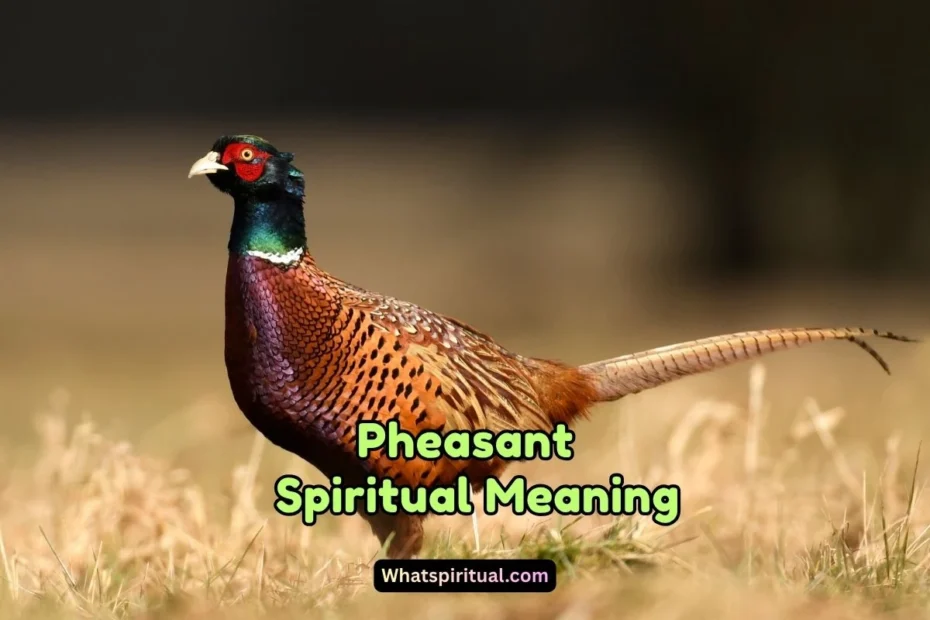
You spot a pheasant. Its feathers catch the light in a burst of copper, gold, and emerald. Something inside you pauses. Your breath slows for just a second. That moment is not accidental. The pheasant spiritual meaning is one of the richest, most layered symbolic traditions in the natural world, spanning thousands of years across Asia, Europe, and indigenous cultures worldwide.
The pheasant has walked beside human civilization since ancient times. It appears in Chinese imperial courts, Greek mythology, Native American ceremony, and Celtic folklore. Spiritual seekers, shamans, and everyday people have long recognized this bird as a messenger of something deeper. Whether you saw one in your backyard, in a dream, or in a vision, you are right to pay attention.
This bird does not appear casually. The pheasant symbolizes beauty, courage, abundance, sexuality, renewal, and the creative fire of life itself. Its presence often signals a time of personal expansion. It pushes you to step into your own brilliance. It challenges you to stop hiding and to display your gifts with confidence.
In this blog post, you will find everything you need to understand the spiritual meaning of the pheasant in full depth. From cultural traditions and mythologies to totem wisdom and dream interpretation, every angle of this extraordinary bird is covered. Read carefully. The pheasant may have appeared in your life for a very specific reason.
Key Takeaways
- The pheasant spiritual meaning centers on abundance, beauty, confidence, and creative expression, urging you to display your authentic self without fear.
- Across Chinese, Greek, Celtic, and Native American traditions, the pheasant is regarded as a sacred, powerful messenger between the earthly and spiritual realms.
- As a spirit animal, the pheasant encourages bold self-expression, sensuality, and a reconnection with your creative potential.
- Dreaming of a pheasant often signals incoming prosperity, a call to action, or a warning against hiding your true capabilities.
- The pheasant appears in Biblical and Christian symbolism as a representation of divine beauty, earthly abundance, and the soul’s longing for a higher connection.
What Is a Pheasant?
The pheasant belongs to the family Phasianidae, which also includes peacocks, turkeys, and quails. Native to Asia, particularly China and Central Asia, pheasants were introduced to Europe, North America, and beyond over centuries of trade and colonization. Today, over 50 species of true pheasants exist worldwide, with the Ring-necked Pheasant(Phasianus colchicus) being the most widely recognized.
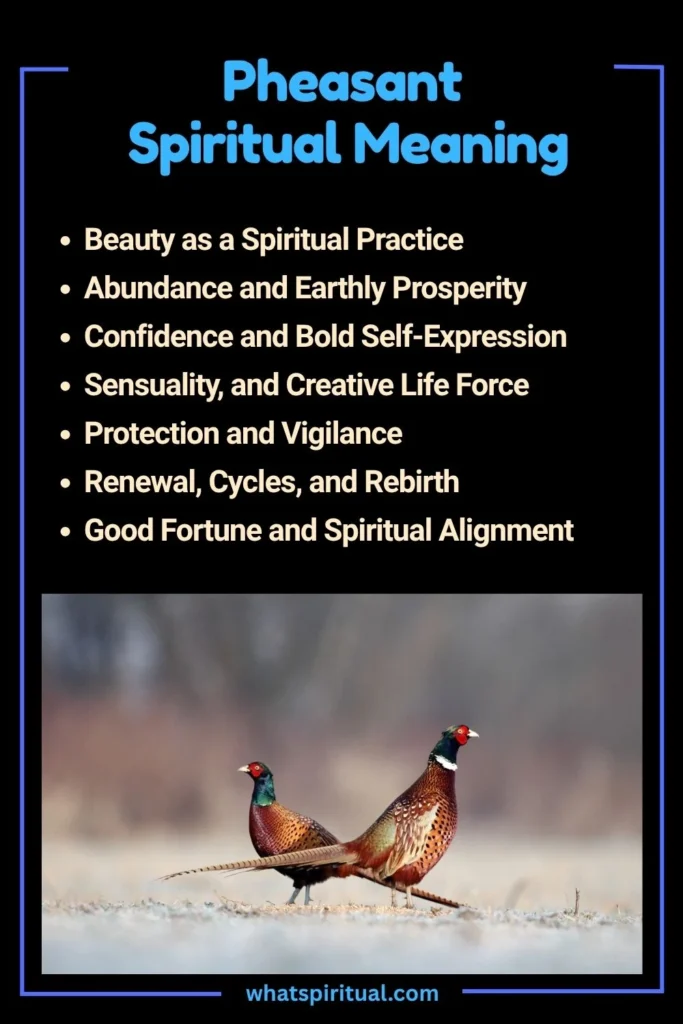
The male pheasant is one of nature’s most visually dramatic creatures. He wears a blaze of iridescent plumage: chestnut, copper, black, white, and deep green. The vivid red wattles on his face and his long, striped tail feathers make him impossible to miss. The female, or hen, takes a more understated brown and buff appearance, built for camouflage rather than display.
Pheasants are ground-dwelling birds. They forage through forests, farmlands, and grasslands. They prefer the edges between open fields and wooded areas, a symbolic position between two worlds. This liminal habitat is spiritually significant in many traditions. A creature that lives on the boundary is seen as a bridge between the seen and the unseen.
What makes the pheasant remarkable from a spiritual standpoint is this contrast between bold visibility and secretive behavior. The male pheasant displays himself with full confidence, yet he is also a master of concealment when threatened. This duality speaks deeply to the human experience of knowing when to shine and when to retreat.
What Does Seeing a Pheasant Mean Spiritually?
Seeing a pheasant in the wild is not something people dismiss quickly. Its colors are too vivid, its presence too deliberate. Spiritually, a pheasant sighting carries specific and actionable meaning for your current life circumstances.
When a pheasant crosses your path, the spiritual world is signaling that a period of abundance and creative flourishing is near. The pheasant’s rich plumage has long been associated with the earth’s generosity. Farmers in medieval Europe considered the pheasant a good omen for harvest. Many shamanic traditions saw the pheasant’s appearance as confirmation that the natural world was aligned and generous.
Seeing a pheasant can also mean that you are being called to greater visibility. If you have been hiding your talents, dimming your light, or playing small in your relationships or career, the pheasant delivers a direct spiritual message. It says: stop shrinking. The male pheasant does not apologize for his beauty. He does not tone himself down for the comfort of others. His display is an act of spiritual courage, and the universe may be asking you to do the same.
A pheasant appearing repeatedly in your life, whether in physical form, in art, in conversation, or in dreams, amplifies this message. Repetition in spiritual symbolism is always significant. It means the lesson or invitation is urgent. The universe rarely shouts. It repeats.
If the pheasant you saw was flying upward, this typically signals spiritual elevation. You may be moving into a higher level of consciousness, relationship, or career. A pheasant standing still often signals patience and timing. A pheasant running or fleeing may suggest that you are avoiding something important in your life that needs confronting.
7 Spiritual Meanings of the Pheasant
1. Beauty as a Spiritual Practice
The pheasant embodies the sacredness of beauty. This is not vanity. It is something far more profound. In many indigenous and Eastern traditions, beauty is not separate from the sacred. Beauty is the sacred, made visible. The pheasant, dressed in its remarkable plumage, lives this truth without self-consciousness.
Spiritually, this meaning calls you to recognize beauty in your own life and in yourself. Many people carry deep wounds around worthiness and self-image. The pheasant offers a healing presence. It reminds you that beauty is not earned through suffering. It exists in you naturally, just as it exists in the pheasant without effort or achievement.
Cultures that honored the pheasant often incorporated its feathers into ceremonial clothing, crowns, and sacred objects. Chinese emperors wore pheasant feathers as symbols of their divine mandate. This was not mere decoration. It was a statement that beauty is connected to power, authority, and spiritual alignment. When beauty is expressed authentically, it carries real spiritual force.
The deeper teaching here is integration. The pheasant does not separate its beauty from its daily life. It forages, rests, and moves through the world in full color. You are being invited to bring your authentic beauty, your gifts, your creativity, and your unique presence, into every part of your life without compartmentalizing it.
2. Abundance and Earthly Prosperity
The pheasant is a powerful symbol of abundance. In Chinese culture, the pheasant was associated with the earth’s generosity and the emperor’s ability to provide for his people. The bird’s plump body, its ground-level foraging, and its preference for fertile farmland all connect it to material and earthly prosperity.
Across European folk traditions, encountering a pheasant during planting season was considered a divine blessing on the crops. Farmers in England and Ireland would take the sighting of a pheasant near their fields as confirmation that the harvest would be plentiful. This is not superstition. This is pattern recognition encoded in generations of lived experience.
When the pheasant appears in your life as a symbol of abundance, it is not simply promising you money or material things. It is pointing to a richness of experience, relationship, creativity, and spiritual life. True abundance, as most spiritual traditions teach, is not purely financial. It is the quality of fullness that comes when you are aligned with your purpose.
The pheasant also teaches the right relationship with abundance. It gathers what it needs from the earth. It does not hoard. It does not waste. Its presence in your life may be an invitation to examine your own relationship with abundance. Are you open to receiving? Do you trust that there is enough? The pheasant’s confidence suggests that the earth provides, and that trust in this provision is a spiritual act.
3. Confidence and Bold Self-Expression
No bird on earth displays itself quite like the male pheasant. His entire biology is built around the act of confident self-expression. He fans his feathers, puffs his chest, and calls loudly across the landscape. He does this not despite predators, but in full knowledge of them. Courage and confidence coexist in the pheasant.
Spiritually, this meaning is one of the most direct the pheasant offers. If you are living in fear of judgment, suppressing your creativity, or waiting for permission to express yourself fully, the pheasant is your spiritual alarm clock. It will not let you sleep through your own life.
Many spiritual teachers across traditions emphasize that self-suppression is a form of spiritual contraction. When you do not express your authentic gifts, you diminish the light available in the world. The pheasant, through its sheer visual courage, models what it looks like to be unapologetically yourself. This is not arrogance. Arrogance comes from insecurity. The pheasant’s display comes from a deep, grounded sense of what it is.
The lesson extends to your relationships and your public life. Confidence is magnetic. It draws opportunity, connection, and abundance. The pheasant does not wait in a corner hoping someone will notice it. It walks into the open field, stands tall, and lets the world see. The spiritual invitation is the same for you: stop waiting. Start showing up.
4. Sexuality, Sensuality, and Creative Life Force
The pheasant is deeply connected to sexuality and creative life force in numerous spiritual traditions. Its vivid colors, elaborate mating rituals, and powerful male energy associate it with the raw creative energy that drives all of life. In Taoist tradition, the pheasant was one of the symbols associated with yang energy: active, outward, creative, and fiery.
This does not make the pheasant’s symbolism purely sexual in a physical sense. Spirituality and sexuality are not opposites. In many ancient traditions, sacred sexuality was understood as a doorway to divine creative power. The pheasant embodies this integration. Its mating display is a spiritual ceremony as much as a biological one.
For those who work with creative energy, whether in art, business, writing, music, or any form of making, the pheasant offers a powerful totem energy. It stirs the creative fires. It says that expression is a sacred act. When your creative energy is blocked or stagnant, the pheasant’s appearance can signal that something within you is ready to burst open.
The pheasant also speaks to the importance of aliveness. This bird is not quiet or reserved in its embodiment of life. It is vivid, loud, physical, and present. This level of aliveness, of being fully in your body and fully engaged with life, is itself a spiritual state. Many traditions teach that embodied presence is the foundation of all spiritual practice.
5. Protection and Vigilance
Despite its bold display, the pheasant is a remarkably alert and cautious creature. It has a sophisticated capacity for detecting danger. It can remain perfectly still, camouflaged in tall grass, while predators pass nearby. It knows precisely when to move and when to wait. This quality gives the pheasant a powerful spiritual meaning connected to protection, discernment, and strategic wisdom.
In shamanic traditions across Eurasia, the pheasant was considered a guardian bird. Its feathers were used in protective talismans. Warriors carried pheasant feathers to sharpen their vigilance in battle. The bird’s ability to navigate between visibility and concealment made it a symbol of wisdom in action, knowing when to be seen and when to disappear.
This protective energy has a deeply personal spiritual application. You live in a world that demands constant navigation between authenticity and strategy. The pheasant teaches that these two forces are not in conflict. You can be bold and beautiful in the right moments, and pull back with intelligence in others. Spiritual discernment is not weakness. It is wisdom.
The pheasant also teaches boundary awareness. It knows its territory. It knows where it is safe and where it is vulnerable. This territorial intelligence is a spiritual lesson about self-preservation, knowing your limits, respecting others’ boundaries, and protecting your own energy with care.
6. Renewal, Cycles, and Rebirth
The pheasant’s annual molting cycle gives it deep spiritual significance around the themes of renewal and rebirth. Each year, the male pheasant sheds his old feathers and grows new, even more spectacular ones. This biological process mirrors one of the most universal spiritual truths: death is not an ending, but a preparation for new life.
Many cultures that tracked seasonal cycles included the pheasant as a symbol of spring renewal. In China, the pheasant’s appearance in art and poetry during spring festivals was deliberate. It carried the energy of the new year, new beginnings, and the earth’s capacity to regenerate itself endlessly.
If the pheasant has appeared to you during a period of personal transition, loss, or uncertainty, its spiritual message is clear. You are in a molting season. Something old is releasing. The feathers that fall away are not a loss. They are making space for something more magnificent. Trust the process. What comes after shedding is always brighter than what came before.
This renewal symbolism also connects to ancestral healing. In some indigenous traditions, the pheasant was believed to carry the prayers of the ancestors across the boundary between the living and the dead. Its presence at times of grief or major life transition was seen as the ancestors themselves making contact to offer reassurance and guidance.
7. Good Fortune and Spiritual Alignment
Across virtually every culture that has known the pheasant, it carries the meaning of good fortune. This is not the shallow fortune of luck or chance. It is the deep, earned fortune that comes from being in right relationship with the universe. The pheasant’s rarity and beauty made it a coveted symbol. Kings and nobles prized it. Temples honored it. Poets wrote of it for centuries.
When the pheasant appears in your life, especially unexpectedly, many spiritual practitioners interpret this as a sign of alignment. The universe is confirming that you are on the right path. The choices you have made, the risks you have taken, the prayers you have sent out, are landing in fertile ground.
This meaning of alignment is particularly powerful during periods of doubt. When you have made a bold decision and are waiting to see the outcome, a pheasant sighting can serve as spiritual confirmation. Many people report feeling immediate relief or calm after spotting a pheasant during a difficult period. This is the soul recognizing the message before the mind has processed it.
The pheasant’s association with good fortune is also tied to gratitude. Spiritual traditions that honored this bird often did so through ceremony and offering. The act of acknowledging the pheasant’s presence, pausing to receive its message, and giving thanks in return, was itself considered a practice that invited more abundance and alignment into one’s life.
Pheasant Meaning and Significance Across Cultures and Religions
Chinese Culture
In Chinese culture, the pheasant holds a position of extraordinary prestige. The Chinese word for pheasant, zhi (雉), appears in some of the oldest Chinese texts, including the I Ching. The pheasant was considered a creature of the south, associated with fire, yang energy, and imperial authority.
Chinese emperors wore robes embroidered with pheasant imagery. Court officials of specific ranks were identified by pheasant feathers in their caps. The golden pheasant (Chrysolophus pictus) became especially significant, associated with virtue, good governance, and the blessing of heaven on earthly rulers. A leader who governed wisely was said to bring the pheasant to his court.
In Chinese Feng Shui, pheasant imagery in the home was believed to attract abundance, protect against negative energy, and stimulate creative and romantic life. Pheasant feathers placed in the southern corner of a home were thought to amplify fire energy and bring vitality to the household.
Japanese Culture
In Japan, the pheasant (kiji, 雉) holds particular cultural and spiritual significance. The green pheasant (Phasianus versicolor) is Japan’s national bird, chosen for its connection to the Japanese landscape and its appearance in the country’s oldest mythological texts.
The pheasant appears prominently in the ancient tale of Momotaro, the Peach Boy, where the pheasant serves as one of the hero’s three loyal companions. In this role, the pheasant represents loyalty, courage, and swift action. Its ability to fly fast and strike quickly made it the ideal warrior companion in the folk imagination.
Japanese Shinto tradition also connects the pheasant to divine communication. The pheasant’s call was believed to carry the voices of the kami (spirits) between the earthly and divine realms. Hearing a pheasant call was considered a sacred moment requiring mindful attention.
Native American Traditions
Native American traditions across several nations honored the pheasant (including related birds like the quail and grouse in some traditions) as a symbol of earth wisdom and seasonal abundance. Ground-dwelling birds held special significance in traditions that emphasized the sacred relationship between humans and the earth.
In some Plains Indian traditions, pheasant feathers were incorporated into ceremonial dress during harvest celebrations. The bird’s connection to the earth’s surface gave it an association with grounding, practicality, and material providence. Tribal healers used pheasant feathers in rituals designed to call abundance and restore balance in communities experiencing scarcity.
The pheasant’s dual capacity for bold display and quiet camouflage also earned it a reputation among some Native peoples as a teacher of balance. Its presence in stories often represented the wisdom of knowing which face to show the world in any given moment.
Celtic Traditions
In Celtic tradition, brightly colored birds were considered messengers from the Otherworld, the Celtic spiritual realm that existed alongside the physical world. The pheasant, with its spectacular plumage, fit this role naturally. Celtic seers and druids paid careful attention to unusual bird encounters, recording their spiritual significance.
The pheasant’s feathers appeared in Celtic ritual objects and personal adornment among peoples in Britain and Gaul. The bird’s connection to the harvest and the autumn season aligned it with Samhain-adjacent symbolism: the thinning of the veil between worlds, the gathering of what has grown, and preparation for renewal through winter.
Celtic stories also connected vivid birds to shape-shifting and otherworldly visitors. A strikingly beautiful bird encountered alone in the forest was sometimes interpreted as a deity, fairy, or ancestor in temporary form, delivering a message to the observer.
Hindu and Vedic Traditions
In Hindu tradition, the pheasant is connected to Kartikeya (also known as Murugan), the god of war and victory. Kartikeya’s vehicle is the peacock, and pheasants belong to the same sacred bird family. Birds of this lineage are associated with divine beauty, warrior energy, and the defeat of ignorance.
The pheasant’s vivid colors also connect it to the Hindu concept of Shakti, the divine feminine creative force that animates all of life. Red and gold, the pheasant’s most prominent colors, are sacred colors in Hindu worship, associated with Lakshmi (goddess of abundance) and Durga (goddess of protection and power).
Pheasant Symbolism in Mythology
Greek and Roman Mythology
The Greek myth of the Argonauts gives us one of the most direct mythological connections to the pheasant. The word “pheasant” itself derives from Phasianus, referring to the Phasis River in the ancient kingdom of Colchis (modern-day Georgia). According to myth, the Argonauts, on their quest for the Golden Fleece, encountered these magnificent birds along the banks of the Phasis River and brought them back to Greece.
This mythological origin story is symbolically rich. The pheasant enters Western consciousness through a story of heroic quest, divine treasure, and the crossing of boundaries. Its very name is rooted in the concept of a journey toward something magnificent. This gives the pheasant an inherent mythological connection to adventurous pursuit and the reward that awaits those who dare to seek.
In Roman tradition, the pheasant became associated with luxury, divine favor, and the pleasures of a well-governed empire. Roman aristocrats kept pheasants in elaborate gardens as symbols of their refinement and their closeness to divine beauty.
Chinese Mythology
In Chinese mythology, the golden pheasant was one of the twelve symbols of imperial authority and was associated with the Five Sacred Mountains and the harmony of heaven and earth. The mythological Fenghuang (Chinese phoenix) is described in ancient texts with characteristics borrowed partly from the pheasant, including its magnificent plumage, its rarity, and its appearance as an omen of a virtuous ruler.
In folk mythology, the pheasant was sometimes depicted as a transformed spirit, a celestial being who had taken bird form to walk among humans and observe the moral character of communities. When pheasants appeared abundantly, it signaled that heaven approved of the people’s virtue. When they disappeared, it was read as a spiritual warning.
Japanese Mythology
In the Kojiki, Japan’s oldest chronicle of mythology (compiled in 712 CE), the pheasant appears as a divine messenger. In one famous episode, the pheasant Naki-me (Weeping Female) is sent by the god Ame-no-Wakahiko as a messenger between heaven and earth. The pheasant’s ability to travel swiftly between the divine and mortal realms established it firmly in Japanese mythology as a creature of celestial communication.
This mythological role reinforces the pheasant’s broader spiritual significance as a boundary-crosser, a being that moves easily between worlds and carries meaning across those crossings.
Pheasant as a Totem, Spirit Animal, and Power Animal
Pheasant as a Totem Animal
If the pheasant is your totem animal, you were likely born with an innate connection to beauty, creativity, and the natural world. People with the pheasant totem often have an extraordinary aesthetic sense. They notice beauty where others walk past it. They are drawn to color, texture, sound, and sensory experience in ways that feel almost spiritual in their intensity.
The pheasant totem also marks a person who carries a natural magnetism. Like the male pheasant’s display, pheasant-totem people attract others through their presence, their creativity, or their personal style. They often do not fully realize how magnetic they are, which can lead to either underusing this gift or feeling overwhelmed by the attention it draws.
Those born under the pheasant totem often struggle with the tension between visibility and safety. The pheasant’s own nature reflects this tension. This can manifest in a lifelong pattern of brilliance followed by withdrawal, bold expression followed by hiding. Learning to hold both qualities in balance is one of the central spiritual lessons of the pheasant totem.
The pheasant totem also gifts its people with extraordinary sensory awareness. Pheasant-totem individuals are often highly intuitive, picking up on subtle changes in their environment, relationships, and spiritual landscape long before others notice them. This makes them natural healers, artists, counselors, and leaders.
Pheasant as a Spirit Animal
Your pheasant spirit animal arrives when you need courage to be seen. It comes when you have been hiding for too long. It arrives in moments of creative block, when your gifts are bottled up inside you with nowhere to go. The pheasant spirit animal does not ask permission to be vibrant. It simply is. It shows you that aliveness itself is the practice.
The pheasant as a spirit animal also teaches you about strategic timing. It does not run blindly into the open. It watches, waits, reads the landscape, and moves when the moment is right. This combination of bold confidence and intelligent patience is rare and powerful. If the pheasant has arrived as your spirit animal, you are being asked to cultivate both qualities with equal devotion.
When working with the pheasant spirit animal in meditation or spiritual practice, focus on the areas of your life where you have been playing small. Ask the pheasant what it sees in you that you have been unable to see in yourself. Many people who connect with this spirit animal report a sudden, unexpected surge of creative energy or a deepening of their capacity for joy.
Pheasant as a Power Animal
As a power animal, the pheasant is called upon when you need a burst of creative energy, visibility, or abundance in your life. Shamanic practitioners who work with the pheasant as a power animal often use its energy before creative projects, public speaking, business launches, or any situation requiring confident self-expression.
The pheasant power animal is also called upon for protection. Its sharp vigilance, its ability to sense danger before it arrives, and its strategic concealment abilities make it a powerful guardian energy. When you feel spiritually vulnerable or are entering a challenging situation, calling on the pheasant power animal can help you navigate with greater awareness and strategic intelligence.
Working with pheasant energy means honoring both your visibility and your inner life. Carry a pheasant feather, use pheasant imagery in your sacred space, or spend time in areas where pheasants are found. These physical connections support the energetic relationship with this powerful animal spirit.
Types of Pheasants and Their Spiritual Meanings
Ring-necked Pheasant
The Ring-necked Pheasant is the most common and widely recognized species. Its distinctive white collar around the neck sets it apart. Spiritually, the white ring symbolizes clarity of communication and the integration of earthly and divine energies. The white ring sits between the vivid body and the iridescent head, bridging two worlds. Encountering a Ring-necked Pheasant often signals a time when clear, honest communication is needed in your relationships or work.
Golden Pheasant
The Golden Pheasant (Chrysolophus pictus) is one of the most spectacular birds in existence. Its deep red, golden yellow, and emerald plumage has made it a symbol of royalty, divine grace, and supreme confidence in Chinese culture for thousands of years. Spiritually, the Golden Pheasant is associated with solar energy, leadership, and the manifestation of divine beauty in the physical world. Seeing or connecting with a Golden Pheasant is considered an exceptionally powerful spiritual omen of incoming abundance and recognition.
Lady Amherst’s Pheasant
The Lady Amherst’s Pheasant carries long, dramatic tail feathers with striking black-and-white patterning. Spiritually, this species is connected to duality, balance, and the integration of opposites. The sharp contrast between black and white in its plumage speaks to the spiritual work of holding paradox: light and shadow, visibility and concealment, action and rest. This pheasant appears spiritually when you are navigating a situation that requires nuanced thinking and balanced perspective.
Silver Pheasant
The Silver Pheasant is associated with purity, spiritual clarity, and the feminine aspects of divine beauty. Its cool, silver-white plumage connects it to lunar energy, intuition, and the reflective, inner dimensions of spiritual life. Where the Golden Pheasant represents solar confidence and outward abundance, the Silver Pheasant represents inner wisdom, stillness, and the grace of quiet strength. Its spiritual meaning often surfaces during periods of introspection, healing, or deep inner transformation.
Reeves’s Pheasant
The Reeves’s Pheasant holds the record for the longest tail feathers of any wild bird species, sometimes reaching over six feet in length. Spiritually, this remarkable feature connects it to legacy, ancestral wisdom, and the long reach of our actions through time. Its tail is a symbol of what we leave behind. Encountering this species in a spiritual context often signals a time to consider the long-term impact of your choices and to honor the wisdom of those who came before you.
Pheasant Biblical and Christian Meaning
The pheasant does not appear by name in the Bible. However, its symbolism aligns powerfully with several key Biblical themes. The bird’s association with beauty, abundance, and the glory of creation connects it deeply to the Psalmist’s declaration that “the earth is full of the glory of the Lord” (Psalm 104).
In Christian spiritual tradition, birds have always held special significance. Jesus himself points to the birds of the air as evidence of divine provision: “Look at the birds of the air; they do not sow or reap or store away in barns, and yet your heavenly Father feeds them” (Matthew 6:26). The pheasant, as a bird of extraordinary natural beauty, can be understood within this framework as a visible testament to God’s creative generosity.
The colors of the pheasant carry their own Biblical resonances. Gold and red, the pheasant’s most prominent colors, appear throughout Scripture in sacred contexts. Gold represents divine glory and purity. Red represents the blood of Christ, sacrifice, and redemption. The pheasant wrapped in these sacred colors can be read as a living symbol of God’s simultaneous glory and redemptive love.
Christian mystics who walked closely with nature, including figures like St. Francis of Assisi and the Celtic saints, would have read the pheasant’s appearance as a divine message. In this tradition, every creature is a word spoken by God. The pheasant, with all its brilliance, speaks of abundance, beauty, and the invitation to live fully in the creative grace of God.
Some Christian symbolism scholars also connect the pheasant’s molting and renewal cycle to the Christian concept of resurrection and spiritual rebirth. Just as Christ conquered death and rose in transformed glory, the pheasant annually sheds its old self and rises in new, magnificent plumage. This parallel is not coincidental. It is a pattern woven into creation by its Author.
Dream About a Pheasant: Meanings and Interpretations
Dreaming of a Pheasant in General
Dreaming of a pheasant is generally a highly positive spiritual sign. Most dream traditions interpret pheasant dreams as omens of incoming abundance, creative breakthroughs, and the recognition of your talents. The pheasant arrives in your dreams when your subconscious and your spirit guides are aligned in wanting your attention on a particular area of growth.
If the pheasant in your dream is vivid and full of color, this intensifies the message of abundance and creative expansion. Your subconscious is drawing your waking awareness toward a part of your life that is ready to flourish. Pay attention to any feelings, locations, or other symbols present in the dream. They will point you toward the specific area of life the pheasant is addressing.
Dreaming of a Flying Pheasant
A pheasant in flight within a dream carries the spiritual meaning of liberation, elevation, and freedom from limitation. Pheasants are ground-dwelling birds that fly only when necessary. Seeing one take flight in a dream represents a moment of decisive action after a period of waiting. Your spirit is signaling that the time for preparation is over. It is time to rise and move.
Dreaming of a Dead Pheasant
A dead pheasant in a dream is not necessarily a negative omen. In the framework of transformation symbolism, the death of the pheasant in a dream often signals the end of a cycle. Something in your life, a relationship, a career phase, a limiting belief, is completing. The pheasant’s death in dream space clears ground for new growth. Approach this dream with curiosity rather than fear.
Dreaming of Hunting a Pheasant
If you dream of hunting a pheasant, this often reflects an active pursuit of abundance or recognition in your waking life. You are reaching for something you deeply want. The outcome of the hunt in your dream matters. If you catch the pheasant, success and fulfillment in your pursuit are near. If the pheasant escapes, your subconscious may be nudging you to refine your approach before moving forward.
Dreaming of a Pheasant Feather
A pheasant feather in a dream carries the concentrated symbolic energy of the pheasant itself. Feathers in spiritual traditions across the world represent messages from the divine, ancestral contact, and spiritual gifts. A pheasant feather appearing in a dream suggests that a specific spiritual gift or creative talent you possess is asking to be acknowledged and put to use.
Dreaming of a Flock of Pheasants
Seeing multiple pheasants in a dream amplifies the themes of abundance, community, and collective creative energy. This dream often signals that collaboration and community will be central to your next phase of growth. You may be entering a period where your gifts are best expressed in relationship with others, rather than alone.
Summary Table: Pheasant Spiritual Meaning at a Glance
| Aspect | Pheasant Symbolism and Meaning |
|---|---|
| Core Spiritual Meaning | Beauty, abundance, confidence, creative expression, renewal |
| Element | Fire (yang energy), Earth (ground-dwelling nature) |
| Colors and Their Meaning | Gold (divine glory), Red (passion, life force), Green (growth, renewal), White (purity, communication) |
| Chinese Symbolism | Imperial authority, divine virtue, prosperity, good governance |
| Japanese Symbolism | Loyalty, courage, divine communication, national pride |
| Native American Symbolism | Earth wisdom, abundance, balance, ceremonial protection |
| Celtic Symbolism | Otherworld messenger, harvest abundance, shape-shifting, divine beauty |
| Hindu Symbolism | Shakti energy, warrior virtue, divine beauty, abundance (Lakshmi) |
| Greek/Roman Mythology | Heroic quest, luxury, divine favor, boundary crossing |
| Biblical/Christian Meaning | God’s creative glory, divine provision, resurrection, sacred beauty |
| As a Spirit Animal | Courage to be seen, creative fire, strategic patience, intuitive awareness |
| As a Totem Animal | Natural magnetism, aesthetic sensitivity, balance between visibility and safety |
| As a Power Animal | Creative energy activation, protection, bold self-expression, confident action |
| Golden Pheasant | Solar energy, royalty, supreme confidence, divine grace |
| Silver Pheasant | Lunar energy, purity, inner wisdom, quiet strength |
| Ring-necked Pheasant | Clear communication, integration of energies, clarity |
| Lady Amherst’s Pheasant | Duality, balance, integration of opposites |
| Reeves’s Pheasant | Legacy, ancestral wisdom, long-term impact |
| Dream: Flying Pheasant | Liberation, elevation, decisive action |
| Dream: Dead Pheasant | End of a cycle, transformation, clearing for new growth |
| Dream: Pheasant Feather | Divine message, spiritual gift, creative talent activation |
| Dream: Flock of Pheasants | Community, collaboration, collective abundance |
| Positive Omen | Abundance, alignment, good fortune, incoming recognition |
| Warning Message | Stop hiding, step into your authentic gifts, honor your visibility |
A Final Note
The pheasant spiritual meaning is one of nature’s most generous gifts to those who pay attention. This bird has walked alongside human civilization across centuries and continents, consistently carrying the same essential message: you are more brilliant than you allow yourself to be.
Whether you encountered a pheasant in your garden, in a dream, or in the pages of a mythology book, the message it carries is personal and precise. You are being asked to step into your beauty without apology. You are being invited into a season of abundance. You are being shown that bold, courageous self-expression is not a luxury. It is a spiritual responsibility.
Take time to sit with the pheasant’s energy. If you are drawn to work more deeply with its symbolism, consider meditating on its colors, keeping a pheasant feather in your sacred space, or spending time in nature where pheasants live. Notice what opens up in your creative life, your relationships, and your sense of personal power.
The next time you see a pheasant, pause. Breathe. Receive the message. The universe rarely sends its most beautiful messengers by accident.