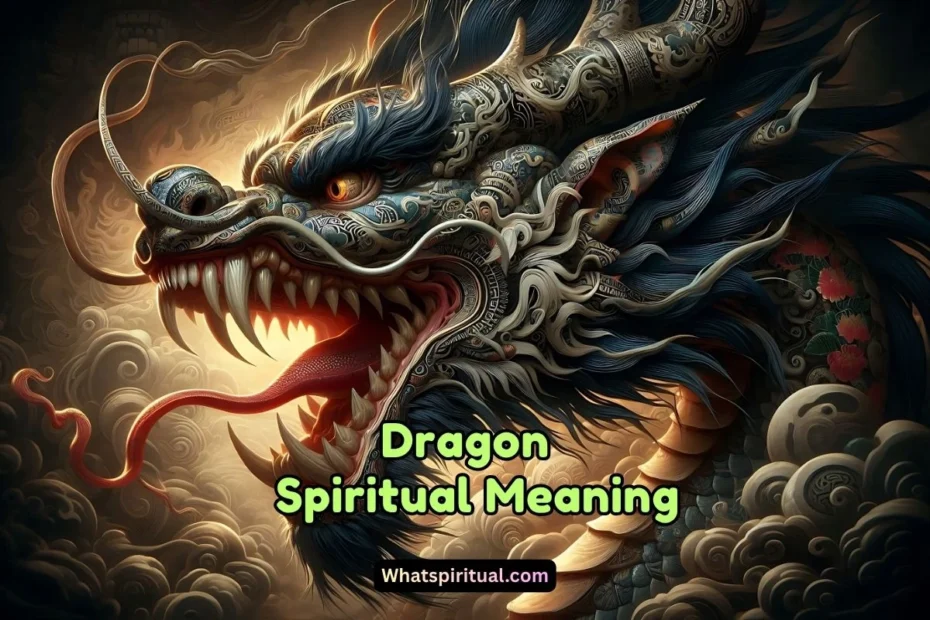
You have seen dragons on ancient temple walls, in epic fantasy stories, and in countless cultural traditions spanning thousands of years. But the dragon is far more than a mythological creature or a fictional character. It is one of the most spiritually potent symbols humanity has ever created, and its presence in your life may carry a message far deeper than you realize.
The dragon spiritual meaning touches virtually every major civilization on earth. Chinese emperors wore dragon robes as a sign of divine authority. Norse warriors called upon dragon energy for courage in battle. Native American traditions honored serpentine dragon-like beings as guardians of water and sky. The sheer universality of dragon symbolism across unconnected cultures is not a coincidence. It points to something deeply embedded in the collective human consciousness.
What makes the dragon particularly fascinating from a spiritual standpoint is its duality. In Eastern traditions, the dragon is almost universally a symbol of good fortune, wisdom, and celestial power. In Western traditions, it often represents chaos, challenge, and the shadow forces that must be overcome. Together, these two perspectives form a complete spiritual picture, one that acknowledges both the light and the dark within us all.
Whether you keep encountering dragon imagery, feel a strong personal connection to this creature, or simply want to understand what the dragon represents on a deeper level, this guide gives you the full picture. From ancient mythologies and religious texts to dream interpretation and spirit animal wisdom, the dragon’s spiritual significance is rich, layered, and profoundly relevant to modern life.
Key Takeaways
- The dragon symbolizes primal power, wisdom, transformation, and protection across nearly every world culture and spiritual tradition.
- In Eastern traditions, dragons are divine, benevolent beings associated with good luck, celestial energy, and imperial authority. In Western traditions, they often represent chaos, shadow, and the internal battles every soul must face.
- A dragon as your spirit or totem animal signals that you are a person of great inner power, strong instincts, and a deep connection to ancient wisdom.
- Dreaming of a dragon carries significant spiritual weight, often pointing to personal transformation, confrontation with fear, or an awakening of hidden power within you.
- The dragon appears in the Bible, Hindu texts, Chinese scriptures, Greek mythology, and Norse legends, making it one of the most cross-cultural spiritual symbols in recorded history.
What Is a Dragon?
The dragon is a legendary, mythical creature that has appeared independently across dozens of unconnected civilizations for thousands of years. Described most commonly as a large, reptilian being with the ability to fly, breathe fire, and command elemental forces, the dragon takes on slightly different forms depending on the cultural tradition that describes it.
In East Asian traditions, particularly Chinese, Japanese, Korean, and Vietnamese cultures, the dragon is typically depicted as a long, serpentine creature with scales, claws, and the ability to control water, rain, and weather. These dragons rarely have wings but move through air and water with supernatural ease. They are considered divine and benevolent beings, closely associated with imperial power and celestial authority.
In Western and European traditions, the dragon is typically depicted as a four-legged beast with large wings, a long tail, and the ability to breathe fire. These dragons guard treasure hoards, terrorize villages, and serve as the ultimate antagonist for heroic knights. They embody raw, untamed power and the shadow forces of nature.
Beyond these two major archetypes, dragons appear in Persian, Indian, Mesoamerican, Celtic, Slavic, and African traditions in various forms. Some are serpentine water spirits. Others are feathered sky gods. Still others are cosmic beings who existed before the world was created. What connects all of these forms is the core energy the dragon represents: immense power, ancient wisdom, and the primal forces of creation and destruction.
What Does Seeing a Dragon Symbolize?
When you encounter the image, symbol, or energy of a dragon, whether in art, dreams, meditation, or synchronistic moments in daily life, the message is rarely simple. The spiritual symbolism of seeing a dragon depends heavily on context, but several core themes emerge consistently across traditions.
Seeing a dragon often signals that you are entering a period of significant transformation. Just as the dragon bridges earth and sky, fire and water, creation and destruction, you may be standing at a threshold between who you have been and who you are becoming. The dragon does not appear during ordinary, uneventful times. It arrives when life is asking more of you.
A dragon sighting or recurring dragon imagery can also point to the awakening of your own inner power. Many spiritual traditions teach that humans carry a dormant creative fire within them, not unlike the dragon’s legendary flame. When the dragon appears in your awareness, it may be inviting you to stop diminishing yourself and step into your full power without apology.
In some traditions, the dragon is a guardian and protector, appearing to signal that you are being watched over by powerful spiritual forces. If you have been feeling vulnerable, lost, or unsupported, the dragon’s presence can serve as a reminder that ancient, powerful energies are working in your favor. You are not alone in whatever battle you are facing.
Finally, seeing a dragon can be a direct invitation to face your shadow. The dragon in Western mythology is often the creature that the hero must confront. Spiritually, this represents the parts of yourself you have avoided, the fears, traumas, and suppressed truths that block your growth. The dragon does not let you run. It stands before you and demands honest reckoning.
9 Spiritual Meanings of the Dragon
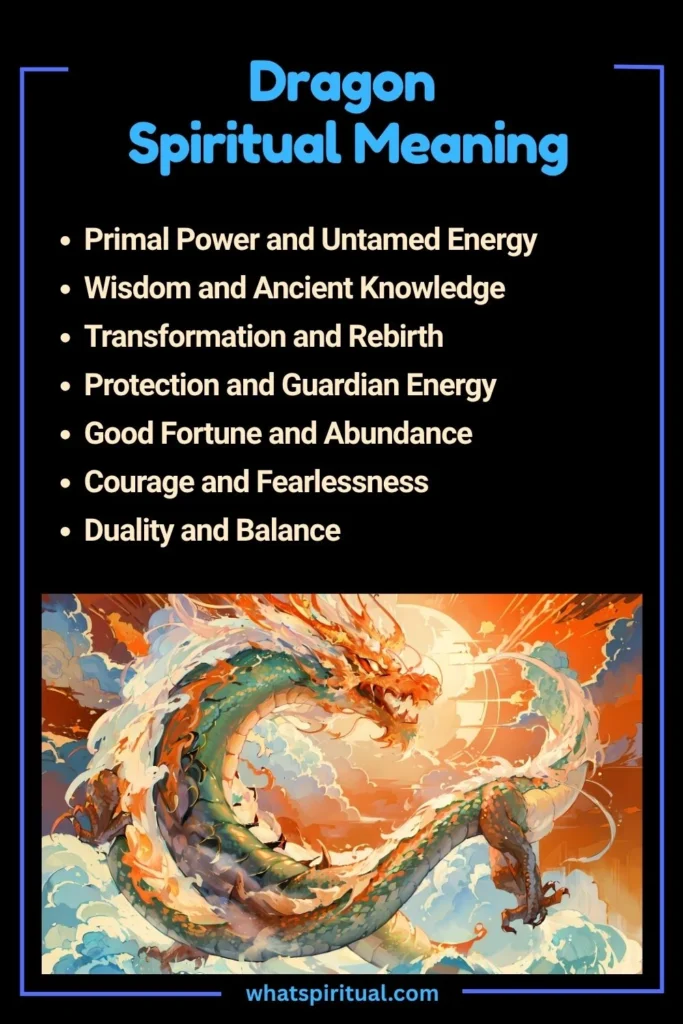
1. Primal Power and Untamed Energy
The dragon is perhaps the most universally recognized symbol of raw, primal power in human history. This power is not the kind that comes from status, wealth, or social position. It is something far older and more elemental. Dragon power comes from the core of existence itself, from the same forces that fuel volcanoes, storms, and the expansion of the cosmos.
Spiritually, the dragon represents the life force energy that runs through all living things. In Chinese spiritual philosophy, this energy is called qi or chi. In Hindu tradition, it is prana. The dragon embodies this energy in its most concentrated, untamed form. When the dragon appears as a spiritual symbol in your life, it often calls you back to this primal vitality within yourself.
Many people who are drawn to dragon energy have suppressed their own power at some point in life. Society often teaches people, particularly women and sensitive individuals, to make themselves smaller and quieter. The dragon spiritually rejects this. Its energy is loud, bold, and unapologetic. It reminds you that your power is not a burden. It is your birthright and your responsibility.
Channeling dragon power in a spiritually healthy way means learning to harness your energy without losing control of it. The greatest dragons in mythology are not chaotic destroyers. They are beings of tremendous restraint who can level mountains but choose to act with precision and purpose. This is the highest expression of dragon power: not force used carelessly, but strength wielded with wisdom.
2. Wisdom and Ancient Knowledge
In virtually every Eastern spiritual tradition, the dragon is a keeper of ancient wisdom. Chinese dragons were considered celestial advisors to the gods themselves. Japanese dragon gods were believed to hold the secrets of the ocean’s depths. In Hindu texts, the serpentine Naga dragons guarded sacred knowledge and spiritual treasures far more valuable than gold.
This association with wisdom comes partly from the dragon’s immense age. In mythology, dragons are often described as beings who have existed since before human civilization. They have witnessed the rise and fall of empires, the birth of mountains, and the turning of cosmic ages. Their wisdom is not book-learned. It is lived, earned, and ancient beyond measure.
Spiritually, when the dragon appears as a symbol of wisdom in your life, it may be pointing you toward knowledge that already exists within you. Not everything you need to know can be found in a book or a teacher’s lecture. Some truths are encoded in your soul, waiting to be accessed through stillness, introspection, and honest self-examination. The dragon’s wisdom says: you already know more than you think you do. Trust it.
There is also a connection between dragon wisdom and the courage to speak truth. In many cultures, the wise dragon tells hard truths. It does not offer comfortable lies or soothing platitudes. If you are spiritually aligned with dragon wisdom, you are likely a person who values truth above comfort, even when the truth is difficult to deliver or receive.
3. Transformation and Rebirth
The dragon’s connection to transformation is one of its most spiritually profound attributes. Fire, the dragon’s most iconic weapon, is simultaneously a force of destruction and purification. Things that enter fire come out fundamentally changed. Old forms are burned away, and something new, refined, and more essential emerges.
In alchemical traditions, the dragon or serpent represented the prima materia, the raw, unformed substance from which gold, or spiritual enlightenment, could be extracted. The dragon presided over the process of dissolution and reformation that alchemists used as a metaphor for spiritual transformation. To become gold, the base material had to be destroyed first.
Dragon symbolism tied to transformation often appears in your life during major life transitions. The end of a relationship, a career change, a spiritual crisis, the loss of a loved one. These are the moments when old identities burn away and something new must be built from the ashes. The dragon’s fire, painful as it is, is ultimately purifying. What survives the dragon’s flame is what is truly real and lasting.
In Chinese culture, this transformative energy is particularly celebrated. The dragon is associated with the yang force in Taoist philosophy, the active, creative, transformative energy that drives change and growth in the universe. To invite dragon energy is to invite radical transformation, and that requires the courage to let the old self be consumed by the flame.
4. Protection and Guardian Energy
Throughout history, dragons have served as guardians of sacred spaces, sacred knowledge, and sacred people. In ancient China, imperial courts were decorated with dragon imagery to signal divine protection. In medieval Europe, churches sometimes used dragon imagery to represent the power of the divine defending the faithful against evil. Norse longships carved dragon heads at their prows to protect sailors and intimidate enemies.
The dragon as protector is a fiercely loyal guardian. It does not protect carelessly or passively. Dragon protection is active, watchful, and powerful. In many traditions, a dragon guardian is awakened by genuine need or sincere devotion. It does not appear to those who are merely curious. It appears to those who need its strength.
Spiritually, the dragon’s protective energy can serve as a reminder that you are supported by forces greater than yourself. If you have been feeling undefended, persecuted, or overwhelmed by negative energies, the dragon symbol may be appearing to tell you that you have more protection than you realize. Ancient, powerful spiritual forces are aware of your situation.
On a personal level, calling upon dragon protective energy in meditation or spiritual practice can help you establish healthy boundaries. The dragon does not allow its sacred space to be violated. It holds its ground with complete conviction. For those who struggle with people-pleasing, codependency, or difficulty enforcing boundaries, dragon energy offers a powerful spiritual model for self-protection.
5. Good Fortune and Abundance
In Chinese and East Asian spiritual traditions, the dragon is the single most powerful symbol of good luck, prosperity, and abundance. The Chinese dragon, or Long, was believed to control rain and water, the lifeblood of agricultural civilization. A dragon’s blessing meant fertile crops, full rivers, and a prosperous harvest. To this day, the dragon remains the most auspicious symbol in Chinese culture.
The Dragon zodiac sign in Chinese astrology is considered the most fortunate birth year. Those born under the dragon are believed to be naturally blessed with charisma, intelligence, ambition, and the ability to attract success. This is not accidental good fortune. It is a reflection of the dragon’s ability to channel the flow of universal abundance.
Spiritually, the dragon’s association with abundance goes deeper than material wealth. It speaks to a fullness of life, a richness of experience, wisdom, and vitality that flows when a person is aligned with their true nature. When the dragon appears as a symbol of abundance in your spiritual journey, it may be pointing to areas of your life where you have been operating from scarcity, and inviting you to shift into a more expansive, receptive state.
Working with dragon energy in the context of abundance and manifestation requires aligning your inner fire with your outer intentions. The dragon’s abundance is not passive. It is the result of powerful creative energy being directed with precision and confidence. You do not attract abundance by wishing for it. You attract it by embodying the full, undiminished power of who you are.
6. Courage and Fearlessness
The dragon is the ultimate symbol of courage. In every tradition where the dragon appears as the creature to be defeated, the act of facing the dragon is the act of facing your greatest fear. The dragon does not hide or shrink. It stands before you in its full, terrifying magnificence and dares you to step forward anyway.
This is why the hero’s journey in Western mythology is almost always, at some point, a dragon encounter. The hero must prove themselves not by avoiding the dragon, but by standing before it. The dragon represents the ultimate test of character, the moment when everything within you is called forth and measured.
From a spiritual standpoint, the courage the dragon tests is not the absence of fear. It is the willingness to act despite fear. Dragon energy teaches that fear is not an obstacle to be eliminated but a signal that something important and soul-level is at stake. The dragon’s fire is terrifying. But those who walk through it emerge fundamentally changed and strengthened.
When dragon energy appears in your life as a symbol of courage, it often arrives during moments when you are tempted to retreat, compromise, or diminish yourself to avoid conflict. The dragon’s message is clear: retreating is not safety. Standing your ground, speaking your truth, and acting from your deepest values is the only path forward that leads to genuine freedom and growth.
7. Duality and Balance
One of the most theologically rich aspects of dragon spiritual symbolism is the way it holds opposites in tension. Fire and water. Creation and destruction. Heaven and earth. Chaos and order. The dragon does not resolve these opposites by choosing one over the other. It embodies both simultaneously and demonstrates that true power lies in their integration.
In Chinese philosophy, this duality is expressed through the yin-yang dynamic. The celestial dragon holds both masculine and feminine energies, both solar and lunar forces. It is not simply a creature of fire or water but a being that moves fluidly between elemental worlds. This is why the Chinese dragon is associated with rain and rivers as much as with lightning and storms.
Spiritually, the dragon’s duality is an invitation to stop seeking simple answers in complex situations. Life rarely presents you with purely good or purely evil options. Most real choices involve holding tension between competing values, needs, and truths. The dragon’s wisdom does not demand resolution. It demands the maturity to sit with complexity without collapsing into black-and-white thinking.
The balance the dragon represents also applies to your own inner life. You contain both light and shadow, strength and vulnerability, wisdom and ignorance. Dragon energy asks you to acknowledge and integrate all of it, not just the parts you find spiritually acceptable. True wholeness requires owning your full complexity, just as the dragon does.
8. Sovereignty and Divine Authority
Across cultures, the dragon has been consistently associated with royal and divine authority. In China, the emperor was called the “Son of the Dragon.” In ancient Mesopotamia, the dragon-like Mushussu was the symbol of the god Marduk and the Babylonian kings who claimed divine right to rule. In medieval Europe, the dragon appeared on the royal standards of Welsh kings and British monarchs.
This association is not merely about political power. It speaks to a spiritual sovereignty that the dragon embodies. The dragon answers to no one. It commands respect not because it demands it but because its power is undeniable. It governs its domain with complete authority, born not from ego but from the absolute alignment between its nature and its actions.
Spiritually, dragon energy as sovereignty invites you to claim authority over your own life. Not domination over others, but mastery of your own inner kingdom. Your thoughts, your values, your direction, your choices. These are your domain. Dragon sovereignty says that allowing other people’s expectations, fears, or judgments to govern your life is a form of spiritual abdication.
People who work with dragon energy in the context of sovereignty often report a gradual but powerful shift in how they carry themselves. There is less need for external validation. There is more confidence in their own perception and judgment. They begin to govern their life from the inside out rather than from the outside in, and this shift is one of the most significant forms of spiritual growth available to a human being.
9. The Breath of Creation and Destruction
The dragon’s fire breath is its most iconic attribute, and it carries deep spiritual significance that goes far beyond physical danger. In many creation myths, the world itself was spoken or breathed into existence by a divine being. The dragon’s fire breath is a symbol of this primal creative and destructive breath, the force that shapes reality at the most fundamental level.
In Sanskrit texts, the Naga dragons are associated with Kundalini energy, the serpentine fire that coils at the base of the spine and rises through spiritual awakening to the crown of the head. This internal dragon fire, when awakened through meditation and spiritual practice, is believed to be one of the most powerful transformative forces available to a human being.
The breath, in virtually every spiritual tradition, is a gateway between the physical and spiritual worlds. Pranayama in yoga, the ruach of the Hebrew Bible, the pneuma of Greek theology. All of these use breath as a metaphor for the divine life force. The dragon’s breath, understood spiritually, is this force at its most concentrated and powerful expression.
When the dragon’s fire breath appears as a spiritual symbol in your life, it may be calling you to pay attention to how you use your own creative power. Your words, your actions, your attention. These are your fire breath. They shape reality around you far more than you may realize. Dragon energy asks you to use them with intention, precision, and reverence, because creation and destruction are always just one breath apart.
Dragon Spiritual Meaning and Significance Across Cultures and Religions
Dragon Symbolism in Chinese Culture
In Chinese culture, the dragon holds the highest position of any spiritual symbol. The Chinese dragon (Long or Lung) is a celestial, benevolent being associated with the Emperor of Heaven and the forces of creation. Unlike its Western counterpart, the Chinese dragon is a guardian and bestower of blessings. It controls rain, rivers, and seas, making it a symbol of life-giving abundance.
Chinese imperial culture was saturated with dragon symbolism. The emperor’s throne was called the Dragon Throne. His robe bore five-clawed dragons, a design strictly forbidden for common people. The five-clawed dragon represented the highest divine authority in the celestial hierarchy, while dragons with fewer claws were associated with lower ranks of nobility.
There are nine types of traditional Chinese dragons, each with specific spiritual functions. The Tianlong guards the heavenly palaces. The Fucanglong protects underground treasures. The Shenlong controls rain and thunder. Together, these nine dragon types represent the complete expression of divine power across all realms of existence.
Dragon Symbolism in Japanese Culture
In Japanese tradition, the dragon (Ryū or Tatsu) shares much of its spiritual character with the Chinese dragon but takes on distinctly Japanese qualities. Japanese dragons are closely associated with water, specifically seas, rivers, and storms. They are often depicted as serpentine beings without wings who inhabit the depths of the ocean or the heights of storm clouds.
The sea god Ryūjin is one of Japan’s most important dragon deities. He rules the underwater palace Ryūgū-jō and commands the tides through magical tide jewels. In Japanese Buddhism, dragons are often depicted as protectors of Buddhist temples and are believed to guard the dharma, the sacred teachings of the Buddha.
Dragon imagery in Japanese culture is deeply woven into spiritual practice. Dragon fountains at Shinto shrines serve as purification stations where worshippers wash their hands before entering sacred space. This associates the dragon directly with spiritual cleansing and the maintenance of sacred boundaries.
Dragon Symbolism in Hindu and Vedic Tradition
In Hindu and Vedic tradition, the dragon takes the form of the Naga, a class of semi-divine serpent beings of enormous power and spiritual significance. The Nagas inhabit the underground realm of Patala and guard cosmic secrets and sacred knowledge. They are associated with water, fertility, rebirth, and the kundalini energy that drives spiritual awakening.
The great serpent Shesha or Ananta, often depicted as a massive many-headed cobra, serves as the cosmic resting place of Lord Vishnu between the cycles of creation. Shesha’s body coils in the cosmic ocean, holding the universe in place. This makes the Naga dragon not merely a guardian but a structural element of cosmic reality itself.
The Kundalini serpent, often called the serpent fire, is one of Hinduism’s most important esoteric concepts. This energy, depicted as a coiled serpent at the base of the spine, awakens through yoga and meditation and rises through the chakras to produce states of profound spiritual illumination. The dragon, in this context, is literally the engine of human spiritual evolution.
Dragon Symbolism in Norse and Celtic Traditions
In Norse tradition, the dragon (Dreki or Ormr) occupies a complex spiritual position. The great serpent Jörmungandr, the World Serpent, encircles the entire earth and holds the boundary between the known world and the outer chaos. At Ragnarök, the Norse apocalypse, Jörmungandr and Thor destroy each other in their final battle, and the world is reborn. This makes the Norse dragon a symbol of both cosmic destruction and cosmic renewal.
The dragon Níðhöggr gnaws at the roots of Yggdrasil, the World Tree, representing entropy and decay as necessary forces in the cosmic cycle. While Western mythology often frames the dragon as purely destructive, the Norse tradition understands it as a necessary agent of dissolution that makes space for new creation.
Celtic dragon traditions are rich with symbolism tied to land, sovereignty, and the sacred landscape. The Celtic Ddraig Goch, the Red Dragon of Wales, remains one of the most recognizable dragon symbols in the world and continues to appear on the Welsh national flag. In Celtic spirituality, dragons were believed to inhabit ley lines, the energetic pathways that flow beneath the earth’s surface, making them guardians of the land’s spiritual power.
Dragon Symbolism in Mesoamerican Traditions
The feathered serpent deity of Mesoamerican civilizations represents one of the most fascinating dragon traditions in the world. Known as Quetzalcoatl among the Aztec and Kukulkan among the Maya, this feathered serpent deity combines the serpent’s earth-wisdom with the bird’s celestial freedom, creating a being that bridges heaven and earth.
Quetzalcoatl was associated with wind, learning, priesthood, and the dawn. He was a creator god and a civilizing force, the bringer of agriculture, writing, and the calendar to humanity. His symbolism tied the dragon firmly to human civilization and spiritual progress rather than to chaos or destruction.
The feathered serpent dragon represents a synthesis of opposites: the earthbound serpent and the sky-borne bird, matter and spirit, time and eternity. This synthesis makes Quetzalcoatl one of the most spiritually sophisticated dragon archetypes in world mythology, one that speaks directly to the human aspiration to transcend the merely physical and connect with the divine.
Dragon Symbolism in Mythologies
Greek and Roman Mythology
In Greek mythology, dragons (Drakōn) are primarily guardians of sacred thresholds. The dragon Ladon coiled endlessly around the tree bearing the golden apples in the Garden of the Hesperides, guarding immortality itself. The Colchian Dragon never slept and guarded the Golden Fleece that Jason and the Argonauts sought as the object of their legendary quest.
The Python, a great serpentine dragon, guarded the navel of the world at Delphi before the god Apollo slew it and claimed the site for his oracle. This myth encodes a spiritual truth: the power of prophecy and divine wisdom requires the conquest of the primal, unconscious serpent forces within us. Apollo’s victory represents the ascendance of rational, solar consciousness over the chthonic, instinctual dragon forces.
The Roman dragon tradition borrowed heavily from the Greek but added a distinctly martial character. Roman legions carried dragon standards called Draconarius into battle, and the dragon became associated with military power and the conquering force of imperial Rome.
Babylonian and Mesopotamian Mythology
One of the oldest dragon myths in recorded history comes from ancient Babylon. The Enuma Elish, the Babylonian creation epic, describes the primordial chaos dragon Tiamat as the mother of all creation. The god Marduk defeats Tiamat and splits her body in two, creating heaven and earth from the two halves.
This myth is extraordinarily rich in spiritual meaning. Tiamat is not simply destroyed. She is transformed into the world itself. The dragon’s body becomes the foundation of reality. This suggests that the primal, chaotic dragon energy is not evil but is the raw material from which order and life are constructed. Creation does not conquer chaos. It reorganizes it.
The Mushussu dragon, the symbol of Marduk himself, represents the tamed and directed power of the dragon. Having conquered Tiamat, Marduk does not eliminate dragon energy. He harnesses it. This is a powerful spiritual metaphor for the relationship between the conscious self and the primal forces of the unconscious.
Egyptian Mythology
In Egyptian mythology, the great serpent Apep (Apophis in Greek) was the dragon of chaos who threatened to devour the sun god Ra during his nightly journey through the underworld. Every night, Ra and his entourage fought off Apep in an eternal battle between cosmic order (Ma’at) and cosmic chaos.
The significance of this myth for dragon spirituality is that the battle never ends. Apep is never permanently defeated. The struggle between order and chaos is eternal, and the maintenance of cosmic harmony requires constant vigilance and effort. This is a spiritually mature teaching that resists the easy narrative of final, permanent victory.
The Egyptian Nehebkau, a benevolent serpent god, represents the protective aspect of dragon energy in Egyptian tradition. Nehebkau’s name means “He Who Harnesses the Spirits,” connecting the dragon to the mastery and integration of spiritual forces rather than their destruction.
Dragon as a Totem, Spirit Animal, and Power Animal
Dragon as a Spirit Animal
When the dragon appears as your spirit animal, it signals that you carry extraordinary inner resources. Spirit animals are not chosen. They choose you, typically appearing during pivotal moments of your life to offer guidance, strength, and wisdom. The dragon as a spirit animal is one of the most powerful spiritual guides a person can have, and it comes with both gifts and responsibilities.
People with the dragon as their spirit animal are typically individuals of deep intensity. You feel things profoundly. Your emotions run hot and fast, like the dragon’s fire. You may have struggled at times to contain or express this intensity in ways that others can receive without being overwhelmed. This is one of the dragon spirit animal’s core lessons: power without wisdom is destructive. Your work is to bring those two forces into alignment.
The dragon spirit animal often appears when you need to step into a leadership role you have been avoiding. You may be downplaying your abilities, deferring to others who are less capable, or allowing false modesty to keep you from claiming your place. The dragon’s arrival as a spirit guide is rarely subtle. It arrives like a flame, burning away excuses and demanding that you rise.
Your dragon spirit animal also gives you a gift of penetrating perception. You see through pretense quickly. You recognize deception and manipulation, sometimes before others in your life have any awareness of it. This gift can feel isolating, but it is a form of the dragon’s ancient wisdom operating through you in real time.
Dragon as a Totem Animal
A totem animal is a symbol carried by a family lineage, a community, or a cultural group. It represents the collective spiritual identity and the sacred qualities that a group aspires to embody. When the dragon serves as a totem animal, it imbues the group or lineage with its core qualities: power, protection, wisdom, and the capacity for transformation.
Families and lineages with the dragon as a totem often carry a powerful ancestral energy. There is strength in the bloodline, perhaps a history of overcoming tremendous adversity or producing individuals of exceptional ability and leadership. The dragon totem connects the living to the strength of their ancestors, reminding them that they come from a lineage of power.
Communities and organizations that work under the dragon totem tend to attract high-intensity individuals who are driven, ambitious, and deeply committed to their mission. These groups are not always comfortable or easy. Dragon energy does not produce placid organizations. It produces ones that accomplish extraordinary things through the sheer force of collective will and vision.
Working with the dragon as a totem means honoring the sacred responsibility that comes with power. Dragon totem groups must be particularly vigilant about how they use their collective strength. Power misused is the dragon’s shadow aspect, and groups that ignore this shadow risk becoming destructive rather than generative forces.
Dragon as a Power Animal
A power animal is called upon deliberately and intentionally for specific purposes, often in shamanic practice or energy work. Unlike a spirit animal that arrives unbidden, a power animal is actively invoked when you need its specific qualities. Calling on the dragon as a power animal is appropriate when you need courage, protection, creative fire, or access to ancient wisdom.
To work with the dragon as a power animal, many practitioners begin with meditation and visualization. You imagine yourself entering a vast, ancient landscape, perhaps a mountain range or a deep cavern, and you call the dragon forth with honest intention. The dragon responds to sincerity. It has no patience for ego-driven requests or manipulative intentions.
The dragon power animal is particularly potent when called upon during moments of creative work. Artists, writers, musicians, and other creators often report that working with dragon energy produces states of intense, focused creative flow. The dragon’s fire becomes the fuel for the creative process, burning away self-doubt and resistance, leaving only the pure act of creation.
You can also call on the dragon power animal for boundary setting and protection. Before entering a difficult conversation, a challenging environment, or a situation where your energy is likely to be drained or threatened, invoking dragon protective energy creates a powerful energetic shield. This is not aggression. It is the establishment of a sacred perimeter around your authentic self.
Dragon Colors and Their Spiritual Meanings
Red Dragon
The red dragon is the most commonly recognized dragon symbol in Western and Celtic traditions. It carries the energy of passion, vitality, courage, and martial strength. In Wales, the red dragon represents the fierce spirit of the Welsh people and their resistance to conquest. Spiritually, the red dragon activates your warrior energy and encourages you to fight for what matters most.
Red is also the color of the root chakra, the energy center associated with survival, instinct, and your most primal connection to the earth. The red dragon, in chakra-based spiritual practices, can be called upon to activate and strengthen this foundational energy, helping you feel more grounded, secure, and confident in your physical existence.
Black Dragon
The black dragon is a symbol of deep mystery, hidden power, and the wisdom of the unconscious mind. In East Asian traditions, the black dragon is associated with the north, winter, and the depths of the ocean. It governs the realm of things that are not yet seen, the potential that has not yet taken form.
Black dragon energy is particularly aligned with shadow work, the spiritual practice of confronting and integrating the hidden, suppressed, or denied aspects of the self. If you are drawn to the black dragon, you may be on a deep journey of self-knowledge, one that requires courage to look honestly at what has been buried.
Gold Dragon
The gold dragon is the highest expression of dragon power in Eastern traditions. Associated with divine wisdom, celestial authority, and the most refined spiritual power, the gold dragon is often depicted as the ruler of all other dragons. In Chinese mythology, the Jade Emperor’s celestial court was guarded by golden dragons.
Gold dragon energy aligns with your highest spiritual potential. It calls you toward enlightenment, mastery, and the full expression of your divine nature. Working with gold dragon energy in meditation can support the opening of the crown and third eye chakras, facilitating greater spiritual clarity, intuitive perception, and access to higher wisdom.
Green Dragon
The green dragon is intimately connected to nature, healing, and the life force of the earth. In Celtic and European traditions, the green dragon is a guardian of the natural world and a symbol of growth, renewal, and the abundance of the living earth. It carries the energy of the heart chakra, the seat of compassion, love, and healing.
Green dragon energy is particularly supportive during periods of recovery, healing, and renewal. If you are recovering from illness, grief, or a period of deep depletion, the green dragon’s energy can help restore your vitality and reconnect you with the natural cycles of rest and renewal.
Blue Dragon
The blue dragon represents wisdom, truth, and the realm of the mind and sky. In Japanese tradition, the Blue Dragon (Seiryū) is one of the four guardian beasts of the cardinal directions, ruling the east and associated with spring and the dawn. It governs the intellectual and spiritual realms, presiding over learning, language, and the creative power of thought.
Blue dragon energy supports clear communication, truthful expression, and intellectual clarity. It aligns with the throat and third eye chakras, making it particularly valuable for those who work with writing, teaching, counseling, or any form of communication that seeks to transmit truth and wisdom.
Dragon in the Bible and Christian Tradition
The dragon in the Bible is one of Christianity’s most complex and theologically rich symbols. It appears in both the Old and New Testaments, most dramatically in the Book of Revelation, where the dragon is identified with Satan and the forces of cosmic evil. The red dragon of Revelation 12:3, described as having “seven heads and ten horns and seven crowns on its heads,” represents the ultimate adversarial force in Christian eschatology.
In Revelation 12:9, the dragon is explicitly identified: “The great dragon was hurled down, that ancient serpent called the devil, or Satan, who leads the whole world astray.” This represents the most negative treatment of dragon symbolism in world religion, casting the dragon as the embodiment of deception, pride, and rebellion against divine order.
However, the dragon tradition in early and medieval Christianity is more nuanced than this single passage suggests. The image of Saint George and the Dragon encodes a spiritual teaching about the conquest of sin and the liberation of the soul (represented by the princess). The dragon in this story is not simply evil but represents the chaotic, untamed forces of the lower nature that must be transformed, not merely destroyed.
In the Old Testament, the sea dragon Leviathan appears in the Book of Job, Isaiah, and Psalms as a symbol of primordial chaos that only God can subdue. Job 41 contains one of the most poetic descriptions of Leviathan in scripture, emphasizing its terrifying power and its complete submission to divine authority. This parallels the Babylonian Tiamat myth and suggests a common ancient understanding of the dragon as the primordial chaos that divine order must encompass and control.
The Hebrew Nachash, the serpent of the Garden of Eden, shares significant characteristics with the dragon archetype. Some early Christian theologians described this being as a winged, upright serpent of great beauty before its fall. Whether or not this interpretation is theologically accurate, it reflects the cultural impulse to connect the biblical serpent with the broader dragon tradition.
Dragon Symbolism in Dreams
Dreaming of a Dragon Flying
When you dream of a dragon flying, the spiritual message typically points to liberation, expanded perspective, and the transcendence of limitations that have kept you grounded. Flight in dreams consistently symbolizes freedom from earthly constraints. When a dragon carries this flight, the message is amplified by the dragon’s power and ancient wisdom.
This dream often appears when you are on the verge of a significant breakthrough. Something in your life that has held you back, perhaps a limiting belief, a toxic relationship, or a professional plateau, is about to be overcome. The flying dragon signals that you have more power to rise above your circumstances than you currently believe.
Dreaming of a Dragon Breathing Fire
A dragon breathing fire in your dream is one of the most energetically charged dream experiences you can have. This image directly symbolizes creative power, purifying transformation, and the burning away of what no longer serves you. It is rarely a dream of threat. It is a dream of profound inner activation.
If the fire is directed at something in the dream, pay close attention to what that something is. The object or situation being burned is likely something in your waking life that needs to be released, transformed, or confronted with full honesty. The dragon’s fire in dreams rarely destroys what is truly valuable. It burns away illusion and pretense.
Dreaming of Fighting a Dragon
Fighting a dragon in your dream activates one of mythology’s most ancient and universal archetypes: the hero’s confrontation with the shadow. The dragon you fight in your dream represents something within you or in your life that feels enormous, dangerous, and potentially overwhelming. But the fact that you are fighting it, rather than fleeing, is already deeply significant.
This dream calls you to identify what in your life demands your full courage and engagement. You may be avoiding a confrontation, suppressing a truth, or running from a transformative challenge that will ultimately bring you to a new level of strength and self-knowledge. The dragon in this dream is not your enemy. It is your greatest teacher in disguise.
Dreaming of a Friendly Dragon
Dreaming of a friendly, helpful, or benevolent dragon is a profoundly positive spiritual experience. This dream indicates that you are in alignment with your own power and that the fierce, primal energies within you are not threats but allies. You have made peace with your intensity, your passion, and your strength.
A friendly dragon in your dream may also represent a powerful protector or guide who is present in your spiritual life. This could be an ancestor, a spirit guide, or the awakened dragon energy within your own higher self. The friendly dragon brings a message of support: you have more resources, more allies, and more power available to you than you know.
Dreaming of a Dragon Egg
A dragon egg in your dream is one of the most potent symbols of untapped potential and imminent new beginnings that the dream world offers. Something enormous, powerful, and transformative is preparing to emerge from within you. The egg stage represents the moment just before birth, when the potential is fully formed but not yet expressed.
This dream often appears when you are on the threshold of a major creative, spiritual, or life transition. A new identity, a new calling, a new relationship with your own power is preparing to hatch. The dragon egg dream asks you to be patient, nurturing, and vigilant. Protect what is forming within you until it is strong enough to emerge.
Summary Table: Dragon Spiritual Meaning at a Glance
| Aspect | Dragon Spiritual Meaning |
|---|---|
| Core Symbolism | Power, wisdom, transformation, protection, sovereignty |
| Eastern Dragon | Benevolent, divine authority, good fortune, celestial wisdom |
| Western Dragon | Shadow, chaos, challenge, the hero’s ultimate test |
| Spirit Animal | Deep personal power, penetrating perception, leadership |
| Totem Animal | Ancestral strength, collective power, group identity |
| Power Animal | Courage, creative fire, protection, boundary setting |
| Red Dragon | Passion, vitality, warrior courage, root chakra |
| Black Dragon | Mystery, shadow work, hidden wisdom, the unconscious |
| Gold Dragon | Divine authority, highest spiritual potential, enlightenment |
| Green Dragon | Healing, nature, renewal, heart chakra energy |
| Blue Dragon | Truth, intellectual clarity, communication, sky wisdom |
| Dream: Flying Dragon | Liberation, breakthrough, transcendence of limitation |
| Dream: Fire-Breathing Dragon | Creative activation, purification, transformative power |
| Dream: Fighting Dragon | Shadow confrontation, courage, inner transformation |
| Dream: Friendly Dragon | Alignment with personal power, protection, inner wholeness |
| Dream: Dragon Egg | Untapped potential, imminent new beginnings, creative gestation |
| Biblical Dragon | Cosmic adversary, primordial chaos, the conquered shadow |
| Chinese Dragon | Imperial authority, rain, abundance, celestial protection |
| Hindu Naga Dragon | Kundalini energy, sacred knowledge, cosmic foundation |
| Norse Dragon | Entropy, cosmic renewal, the cycle of destruction and rebirth |
| Celtic Dragon | Land sovereignty, ley lines, the sacred natural power |
A Final Note
The dragon spiritual meaning is not a relic of ancient mythology. It is a living, breathing symbolic force that continues to speak to the deepest dimensions of the human experience. Whether you encounter the dragon in a dream, feel called to it as a spirit or power animal, or simply sense a resonance with its imagery, the dragon’s message is always fundamentally the same: you are more powerful than you know, and that power carries sacred responsibility.
The great gift of working with dragon energy is that it does not allow you to stay small. It pushes you toward the full expression of who you are, even when that is uncomfortable, even when it disrupts familiar patterns, and even when it requires you to walk through fire first. The dragon’s fire is not punishment. It is invitation.
As you take the dragon’s symbolism into your own spiritual practice, consider journaling about which aspects of dragon energy most resonate with you. Meditate on the color of dragon that feels most aligned with your current needs. Pay attention to dragon imagery that appears spontaneously in your environment, your reading, or your dreams. These are not coincidences. They are the dragon making itself known.
Most importantly, honor the dual nature of what the dragon represents. It is both the challenge and the guide, both the fire and the phoenix that rises from it. In that duality lies one of the most complete spiritual teachings available to us: transformation requires destruction, strength requires restraint, and the greatest power is the power that is consciously, wisely, and courageously chosen.