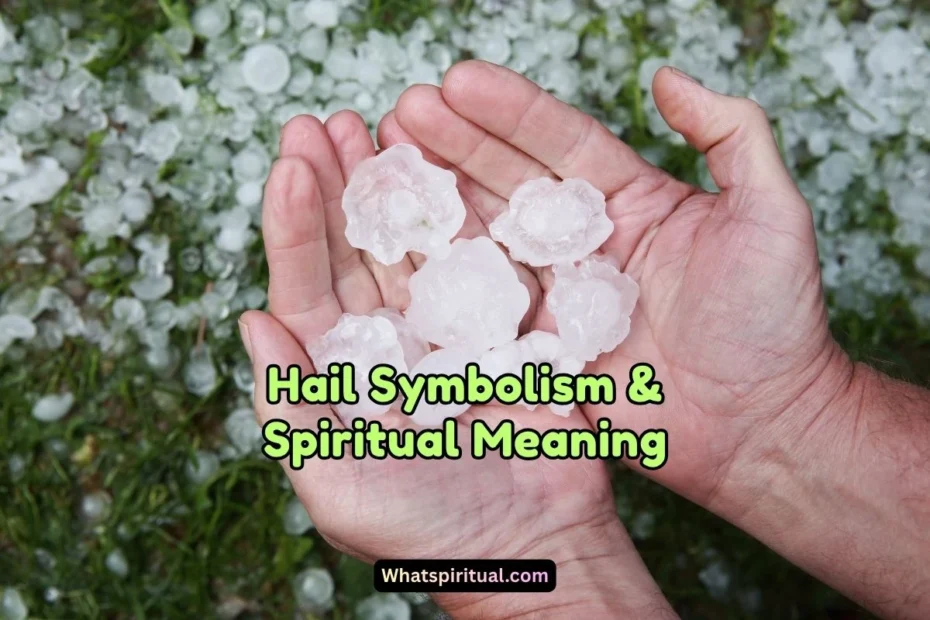
You have seen it before. The sky darkens without warning, the temperature drops, and then it comes: a barrage of frozen pellets hammering the earth with force and fury. Hail is one of nature’s most dramatic displays. Most people rush for cover and wait for it to pass. But across centuries and civilizations, the wisest among us have stopped to ask a deeper question: what does it mean?
The spiritual meaning of hail has fascinated prophets, mystics, shamans, and everyday people for thousands of years. From the plains of ancient Mesopotamia to the highlands of the Andes, falling ice from the sky was never treated as a random meteorological event. It was a message. A signal. A force that carried divine intention. Whether it appeared as a warning, a purification, a judgment, or a breakthrough, hail carried weight far beyond its physical impact.
In the Bible, hail appears as one of God’s most powerful instruments of divine action. In Indigenous traditions, it holds the energy of transformation. In dreams, it speaks directly to your subconscious about forces shaking up your world. This post pulls all of that together and gives you a thorough, grounded look at the hail spiritual meaning and symbolism that has shaped human understanding across time and culture.
Key Takeaways
- Hail spiritually represents divine power and intervention, often appearing in religious texts and traditions as a direct act of a higher force breaking into the physical world.
- The symbolism of hail includes purification, judgment, and warning, with many cultures interpreting it as a signal that something in life needs to change or that a season of hardship is imminent.
- Hail in dreams carries specific messages about challenges, emotional storms, or the clearing of old energies, depending on the context and how the dreamer responds to it.
- Across multiple world religions, including Christianity, Islam, and Indigenous spiritual systems, hail is recognized as a carrier of sacred meaning and divine communication.
- Hail also symbolizes resilience and renewal. After the storm passes, the earth is washed clean, reminding you that periods of intense difficulty often precede growth and fresh beginnings.
What Is Hail?
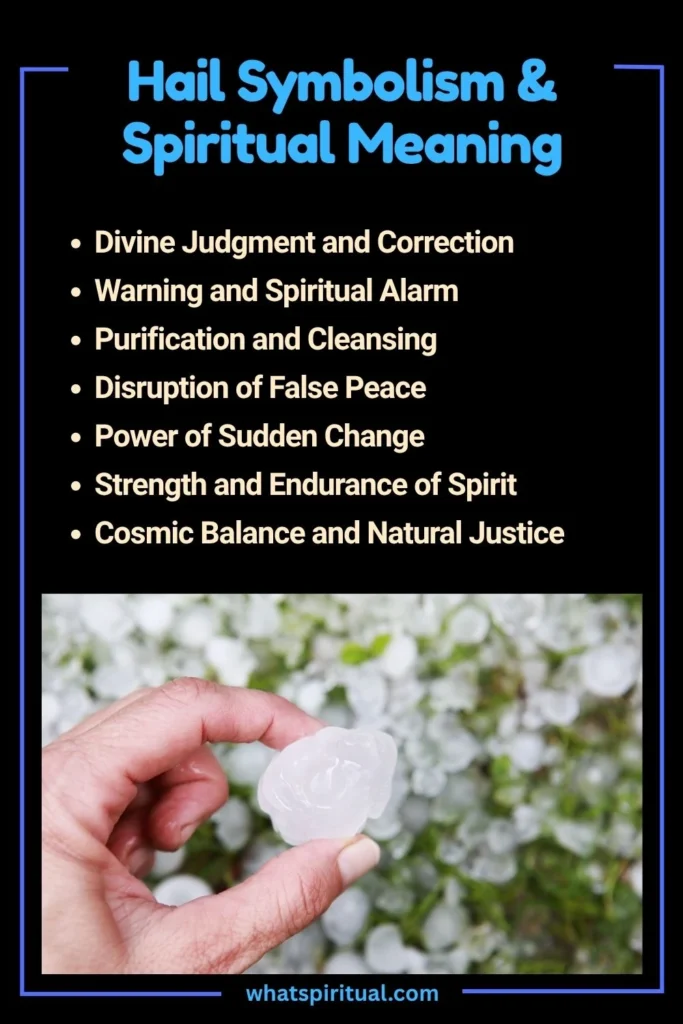
Hail is a form of solid precipitation that forms inside powerful thunderstorm clouds called cumulonimbus. Unlike snow, which forms slowly in cold upper atmospheres, hail is born from violent updrafts that carry water droplets high into freezing air. Those droplets freeze, then fall and get swept back up again, each cycle adding another layer of ice. The result is a compact ball of frozen water, ranging in size from a small pea to, in extreme cases, the size of a baseball or larger.
What makes hail spiritually significant is not just its composition, but its behavior. It falls with force. It comes unexpectedly. It destroys crops, dents cars, strips leaves from trees, and drives people indoors. Ancient peoples had no meteorological explanation for it. They saw the sky unleashing something that felt intentional. The violence of hail felt personal. That raw, sudden, destructive power made it a natural symbol for divine wrath, cosmic disruption, and spiritual confrontation.
In spiritual terms, hail sits at the intersection of the heavenly and the earthly. It originates high in the atmosphere, formed in clouds that many traditions associate with the dwelling place of gods or divine energy. Then it descends forcefully to the ground. This movement from above to below, from heaven to earth, is a pattern that spiritually minded people across all cultures have recognized as a symbol of communication between the divine realm and human life.
What Does Seeing Hail Symbolize Spiritually?
When you witness a hailstorm, the experience is hard to ignore. The sound alone is startling: a relentless drumming against rooftops, windows, and ground. Spiritually, that very intensity is part of the message. Hail does not whisper. It demands attention. Many spiritual traditions teach that when the universe needs you to stop, pay attention, and reconsider your path, it will send something you cannot tune out. A hailstorm qualifies.
Seeing hail can symbolize that you are moving through a period of intense spiritual testing. The frozen nature of hail, water solidified under pressure, speaks to emotions or situations that have hardened. Things that were once fluid in your life may have become rigid or stuck. The storm forces them to break open, hit the ground, and eventually melt away. This is the cycle of breaking down what no longer serves you.
In many traditions, hail also symbolizes sudden clarity. The storm shocks you out of a comfortable but unconscious routine. Just as a cold splash of water can snap you awake, a hailstorm spiritually represents a jolt to your awareness. Something in your life has been brewing, and the hail marks the moment it can no longer stay contained. After the storm passes, the air is unusually clear. That clarity is the spiritual gift hidden inside the chaos.
9 Spiritual Meanings of Hail
1. Divine Judgment and Correction
The most ancient and widespread spiritual meaning of hail is divine judgment. In the Hebrew Bible and the Old Testament, hail is used repeatedly as an instrument of God’s corrective power. The seventh plague of Egypt in Exodus 9 brought hail so severe that it struck down crops, livestock, and people who did not take shelter. The message was not random punishment. It was a targeted divine correction aimed at a system that was built on oppression and injustice.
Spiritually, this meaning translates beyond ancient plagues. When hail appears in your life, whether literally or as a recurring symbol in dreams and visions, it can signal that something in your world is under divine scrutiny. Actions, relationships, or systems that are out of alignment with truth may be coming under review. The hail does not destroy arbitrarily. It strikes what is exposed and unprotected, meaning what lacks spiritual covering or integrity.
The key lesson here is not fear but accountability. Hail as divine judgment is not a punishment designed to break you. It is a correction designed to redirect you. The same storm that destroys a bad harvest clears the field for a new and better planting. Many people who have experienced major life disruptions, financial collapses, relationship endings, or career reversals report, in hindsight, that those painful events were the very thing that set them on a better path.
2. Warning and Spiritual Alarm
Hail as a spiritual warning appears in traditions across the world. Before the storm fully arrives, there are signs: a greenish sky, an eerie calm, a sudden drop in temperature. Spiritually, this progression mirrors the way warnings arrive in life. You often feel something coming before it lands. The appearance of hail, or its repeated appearance in visions or dreams, can be the universe telling you to take stock of your current direction before the full weight of consequences arrives.
In prophetic traditions, hail has long been viewed as an omen that calls for preparation and self-examination. The book of Revelation (8:7) describes hail and fire mixed with blood as the first trumpet judgment, a dramatic cosmic alarm signaling the beginning of a new and challenging epoch. Whether you read this literally or symbolically, the message is consistent: hail signals a threshold. Something is about to shift, and the wise person pays attention rather than dismissing the signs.
On a personal level, experiencing a hailstorm during a significant life moment can serve as a powerful intuitive signal. Ancient spiritual teachers believed that outer weather events could mirror inner spiritual states. A hailstorm during a time when you are about to make a major decision can be interpreted as an invitation to pause, pray, meditate, or seek counsel before proceeding. The spiritual alarm of hail is not meant to paralyze you. It is meant to sharpen your attention.
3. Purification and Cleansing
Water in all its forms has long been associated with purification and spiritual cleansing. Hail is water that has been transformed through an intense process of pressure, cold, and atmospheric force. This transformation adds a dimension of depth to its purifying symbolism. Hail does not gently wash. It scrubs. It strips away. It clears everything off surfaces that had been accumulating dust, debris, and stagnation.
In this sense, the spiritual meaning of a hailstorm can be the forceful removal of what no longer belongs in your life. Old patterns that you have been reluctant to release, relationships that have run their course, beliefs that no longer reflect your growth: these are what the spiritual hail targets. The process is uncomfortable, even painful. But the result is a clearing that could not have happened through gentle rain alone. Some levels of stagnation require a more forceful kind of spiritual detox.
Many mystics and spiritual teachers across different traditions have spoken of “trials by storm” as a necessary part of the soul’s refinement. The process is similar to how blacksmiths used extreme temperature changes to strengthen metal. Hail’s purification is not gentle. It is the kind that forges. After it passes, what remains standing is what was truly solid all along. This is the deeper gift of hail as purification: it reveals your actual spiritual foundation by testing everything built on it.
4. Disruption of False Peace
One of the most spiritually challenging meanings of hail is its role as a disruptor of false peace. There are seasons in life where everything looks calm on the surface, but something underneath is wrong. Relationships that look fine but feel hollow. Careers that look successful but feel misaligned. Beliefs that look solid but have quietly stopped being true. A hailstorm, spiritually, is what breaks through that surface calm to force honesty.
In Ezekiel 13:11-13, God uses hail as a metaphor for the destruction of walls built with “untempered mortar,” meaning structures built without integrity. The spiritual lesson is sharp: what is built on false foundations will not stand when the storm comes. Rather than seeing this as a threat, it is an invitation to examine what you have constructed in your life. Are your foundations real? Are your relationships built on honesty? Is your spiritual life built on genuine seeking or comfortable performance?
The disruption of false peace is ultimately an act of mercy. A life built on illusions will eventually collapse. Hail, spiritually, chooses the timing of that collapse to give you the chance to rebuild on something real. Many people report that their greatest periods of growth followed their most destructive storms, not in spite of the destruction, but precisely because of it. The hail did not destroy their life. It destroyed the version of their life that was holding them back.
5. The Power of Sudden Change
Hail arrives without gradual build-up. One moment the sky is overcast, the next, ice is falling from the sky with enough force to shatter glass. This suddenness is spiritually significant. Many of life’s most transformative moments do not arrive on a schedule. They arrive in an instant, catching you off guard, forcing you to respond immediately with whatever wisdom and strength you have cultivated. Hail is a symbol of that kind of sudden, unavoidable change.
Spiritually, the appearance of hail can signal that a period of rapid, unexpected transformation is approaching or already underway. The universe does not always give warning. Sometimes the change is the warning. The spiritual task is not to predict every hailstorm. It is to build the kind of inner strength and flexibility that allows you to respond wisely when the storm arrives. Resilience is the spiritual currency of those who weather hail.
This meaning is also connected to the concept of divine timing. In many spiritual traditions, things happen when they are meant to happen, not a moment sooner. A hailstorm that seems to arrive at the worst possible time may, from a broader spiritual perspective, be arriving at exactly the right moment. The seed needs to crack before it can sprout. The shell needs to break before the new life inside can emerge. Sudden change, represented by hail, is often the crack that lets the light in.
6. Strength and Endurance of the Spirit
Not everything hail hits is destroyed. Trees bend but many survive. Buildings shake but strong ones hold. Animals and people who take proper shelter emerge unharmed when the storm passes. This aspect of the hailstorm carries a powerful spiritual message about inner strength. The storm tests. What is deeply rooted, properly built, and well-sheltered endures. What is shallow, brittle, and exposed does not.
When you face a spiritual hailstorm in life, the experience reveals your actual spiritual depth. Periods of hardship, loss, illness, betrayal, or sudden upheaval act like hail. They do not create your strength or your weakness. They reveal which one was already there. This is why spiritual traditions across the world emphasize the importance of building inner life during calm seasons. Prayer, meditation, community, service, and integrity are the shelter you build before the hail arrives.
Many of history’s most spiritually powerful figures were forged through intense hardship. Job in the Bible endured loss so extreme it defies imagination, and emerged with a deeper knowledge of God than he had before the storms. The Sufi poet Rumi wrote his most enduring work from the depths of grief. Hail spiritually symbolizes the forge, and those who come through it carry a depth and warmth that people who have only known calm weather rarely possess.
7. Cosmic Balance and Natural Justice
Several spiritual traditions view hail as an agent of cosmic balance and natural justice. In these frameworks, the universe is not random. It operates according to deep principles of cause and effect, sowing and reaping, action and consequence. When imbalances accumulate, whether in an individual life, a community, or a society, the universe corrects them. Hail, in this symbolic context, represents that corrective force arriving at scale.
Indigenous traditions from the Great Plains of North America to the highlands of the Andes viewed hailstorms as expressions of the living intelligence of the natural world. The storm was not blind. It had purpose. Hail destroyed crops that had been grown through exploitative farming practices. It struck areas where the relationship between people and land had grown arrogant or disrespectful. This is not superstition. It is a sophisticated spiritual framework that recognizes the relational nature of all existence.
For you personally, this meaning invites reflection on where your own life may be out of balance. Where have you been taking more than you give? Where have you been exploiting rather than stewarding? Where have you been ignoring consequences that are building up? The spiritual hail of cosmic justice does not arrive with malice. It arrives with the simple, impersonal precision of a scale returning to center. Alignment is always the answer to the threat of the storm.
8. Renewal and New Beginnings
After every hailstorm, the world looks different. Sometimes it looks damaged. But it also looks washed. The air carries a sharp freshness. The ground, even where it is bruised and battered, is cleared. Water from the melted hail soaks into the soil. Within days, green growth often appears where the storm seemed to have done only damage. This cycle of destruction followed by renewal is one of the most profound spiritual meanings of hail.
In seasonal spiritual traditions, the late-spring hailstorm that damages early crops has long been understood as part of a larger natural rhythm. The destruction makes space. Old growth that was weak or diseased is cleared. The remaining plants grow stronger in its absence. New seeds get access to the light and water they need. Spiritually, the same dynamic applies to your life. Loss creates space. Crisis clears the crowded field of your attention. The pain of the hailstorm creates the conditions for a better harvest.
Many people who have survived their spiritual “hailstorms” describe a profound sense of clarity and renewal in the aftermath. Old identities that were ready to be released were finally shed. New priorities that had been struggling to emerge finally broke through. Relationships that had been suffocating were finally released, making room for connections that were genuinely life-giving. The spiritual renewal after hail is real, but you have to walk through the storm to reach it.
9. A Call to Spiritual Awakening
Hail has long been interpreted as a cosmic wake-up call. In prophetic and mystical traditions, natural phenomena that break the ordinary pattern of weather were seen as invitations for humanity to lift its eyes from the routine and pay attention to something larger. A hailstorm breaks the comfortable predictability of an ordinary day. It demands that you stop what you are doing, move to shelter, and wait. That enforced pause is itself a spiritual practice.
In many shamanic traditions, sudden and dramatic weather events were viewed as the spirit world breaking through the veil of ordinary reality to communicate something urgent. A hailstorm was not an obstacle. It was an opening. Shamans, seers, and spiritual leaders often paid close attention to the timing of hailstorms relative to events in the community. A hailstorm during a time of collective moral drift was read as an invitation to return to right relationship with the sacred.
For you, a hailstorm may arrive at exactly the moment when your spiritual life has grown dull or mechanical. The noise of the ice against your window breaks through the noise of your routine. The forced stillness of sheltering in place creates the conditions for genuine reflection. Hail, spiritually, asks you to wake up. It asks you to look at your life with fresh eyes, to question what you have been assuming, and to open yourself to the deeper currents of meaning that run beneath the surface of everyday experience.
Hail Symbolism and Significance Across Cultures and Religions
Ancient Mesopotamia
In ancient Mesopotamian cosmology, weather was the direct expression of divine will. The Babylonian god Adad (also known as Hadad among the Semitic peoples) was the storm deity who controlled thunder, lightning, rain, and hail. Adad was a complex figure: simultaneously a god of destruction and a god of agricultural abundance. Hail falling on crops could mean either divine punishment for communal sin or the reshaping of the agricultural landscape to serve a larger divine plan.
Priests and diviners in these cultures carefully tracked weather events, including hailstorms, as part of their omen literature. Collections of omens known as “Enuma Anu Enlil” recorded the spiritual significance of weather phenomena. Hail was consistently associated with royal fates and national fortunes. A hailstorm before a battle could mean the army would face powerful opposition. A hailstorm during harvest season could mean a change in political leadership was imminent.
Ancient Egypt
In ancient Egypt, hail held particular power as a symbol of divine disruption. Egypt’s climate was relatively dry and stable, which made the rare occurrence of hail even more striking and significant. When it fell, it was interpreted as a direct communication from the gods, bypassing the ordinary rhythms of nature to deliver an urgent message. The seventh plague of Exodus, set in Egypt, was a hailstorm so severe that it killed anyone caught in the open, making it one of the most powerful divine interventions in the entire biblical narrative.
Egyptian mythology also connected hail to the forces of chaos, known as “Isfet,” which stood in opposition to Ma’at, the cosmic principle of order, truth, and justice. A hailstorm in Egypt was thus seen as the temporary ascension of chaos over order, a disruption that called for ritual response, prayer, and renewed commitment to right living. Hail was not permanent chaos. It was a temporary disruption that ultimately served the restoration of balance.
Norse and Germanic Traditions
In Norse mythology, hail was closely linked to Thor, the god of thunder, and to the chaotic forces of the natural world that the gods constantly struggled to keep in check. Hailstorms were sometimes attributed to the battles between divine and chaotic forces playing out in the heavens. The sound of hail was the echo of those cosmic conflicts reaching the earthly realm. Norse peoples treated hailstorms with deep respect, recognizing them as expressions of forces far beyond human control.
Germanic folk traditions developed a rich set of practices around hailstorms. Bells were rung to drive away hail. Prayers and incantations were offered to protective saints. Special herbs were hung above doorways to shield homes and barns. These practices reflect the widespread belief that hail carried spiritual agency and could be addressed and negotiated with through spiritual means. The hailstorm was not simply weather. It was a spiritual event requiring a spiritual response.
Indigenous American Traditions
Among many Indigenous North American peoples, hail was understood as an expression of the Thunder Beings, powerful spiritual entities who governed weather and maintained cosmic balance. The Lakota called them Wakinyan, and viewed hailstorms as their most forceful communication. A hailstorm was a sign that the Thunder Beings were displeased, or that they were performing a necessary spiritual cleansing of the land. Certain ceremonies were performed in response to hailstorms to restore harmony and express gratitude even for difficult weather.
Andean traditions in South America viewed hail as a test of agricultural communities’ relationship with Pachamama, the earth mother. When hail destroyed crops, it was interpreted not as randomcruelty but as a sign that the community needed to renew its spiritual commitments, perform neglected ceremonies, or address internal conflicts that had disrupted communal harmony. The hail thus served as both diagnosis and catalyst, identifying where healing was needed and forcing the community to address it.
Islamic Tradition
In Islamic cosmology, all natural phenomena are understood as expressions of Allah’s sovereignty and wisdom. The Quran explicitly mentions hail as one of the natural instruments through which Allah exercises divine will. Surah An-Nur (24:43) describes Allah sending down hail from mountains of clouds in the sky, striking with it whom He wills and turning it away from whom He wills. The spiritual implication is clear: hail is not random. It is directed by divine intelligence for purposes that may not always be immediately apparent to human understanding.
Islamic scholarship has historically encouraged believers to respond to dramatic weather events, including hailstorms, with prayer, reflection, and gratitude. Even a difficult natural event like hail is viewed as an opportunity to remember one’s dependence on Allah and to renew one’s submission to divine will. The spiritual response to hail in Islam is not fear or complaint, but deepened trust and remembrance. The storm is a reminder of the limits of human control and the vastness of divine power.
Hail Symbolism in Mythologies
Across world mythologies, hail occupies a specific and consistent role as a weapon of the gods. In Greek mythology, Zeus wielded storms, thunder, and hail as expressions of his authority over the cosmic order. When Zeus sent hail, it was a demonstration of power designed to remind mortals and gods alike who held ultimate sovereignty over the natural world. The Iliad contains multiple passages where hail-like storms are used metaphorically to describe the overwhelming force of divine or heroic power in battle.
Hindu mythology presents a fascinating parallel. Indra, the god of storms and king of the gods in the Vedic tradition, wielded the Vajra, a thunderbolt weapon that brought both lightning and hail. The great battle described in the Rigveda between Indra and the drought-demon Vritra resulted in a cosmic release of water in all its forms, rain, rivers, and frozen precipitation. Hail in this context represents the power of truth and righteousness breaking through obstruction. The storm is not merely destructive. It is liberating.
In Aztec mythology, the rain and storm deity Tlaloc held dominion over hail along with rain and thunder. Tlaloc was a deeply ambiguous divine figure: essential for life-giving rain but also capable of sending destructive hail and violent flooding. Offerings and ceremonies were conducted specifically to appease Tlaloc and prevent his destructive aspects from overwhelming his life-giving ones. This mythological framework reflects a sophisticated understanding that the same divine force that nourishes can also destroy, depending on the balance maintained between human communities and the sacred world.
Celtic mythology also contained references to storm deities who sent hail as expressions of divine displeasure or cosmic correction. The great storms described in Celtic literature often arrived as supernatural confirmations of moral or political truths. A hailstorm during an unjust king’s reign was taken as a sign that the land itself was rejecting the corruption at its center. The land, weather, and moral order were understood as deeply interconnected, with hail serving as the most dramatic signal when that connection had been violated.
Hail as a Spiritual Totem, Spirit Animal, and Power Symbol
While hail is a weather event rather than an animal or plant, many spiritual traditions assign it the role of a power symbol or spiritual totem in its own right. Those who feel a deep, intuitive connection to hailstorms, who feel energized rather than frightened when they arrive, who consistently encounter hail imagery in dreams, visions, or meaningful moments, may find that hail functions as a significant spiritual symbol in their personal cosmology.
As a spiritual totem or power symbol, hail carries several specific qualities. It represents the ability to break through stagnation with force. It symbolizes the courage to disrupt comfortable but unhealthy patterns. It embodies the paradox of something cold and hard serving a warm and life-giving purpose, clearing the way for new growth. People under the influence of hail as a spiritual symbol tend to be agents of necessary disruption, people who arrive in situations and shake things up in ways that ultimately serve the highest good, even if they are not immediately appreciated.
If hail appears repeatedly as a symbol in your spiritual life, through dreams, recurring weather experiences during significant moments, or a persistent inner resonance with hail imagery, it may be inviting you to step into this role more consciously. The spiritual power of hail is not aggression or careless destruction. It is the willingness to be an instrument of divine correction, to speak truth that disrupts false peace, to break open what has grown rigid, and to trust that the clearing created will eventually bloom.
Hail Biblical Meaning and Significance
The Bible contains more than a dozen direct references to hail, making it one of the most consistently spiritually significant weather events in Scripture. The most famous appearance is in Exodus 9:13-35, the seventh plague of Egypt. God commanded Moses to announce the coming hailstorm, giving the Egyptians who feared God the chance to bring their slaves and livestock indoors. Those who ignored the warning suffered the full force of the hail. This detail is profoundly important: the hail was not indiscriminate. It was a test of responsiveness to divine warning.
Joshua 10:11 records another dramatic moment where God used hail as a weapon on behalf of the Israelites during the battle of Gibeon. “The LORD hurled large hailstones down on them, and more of them died from the hail than were killed by the swords of the Israelites.” The hail was not just weather accompanying a battle. It was an active divine participant, fighting on behalf of a specific cause. This passage reinforces the biblical understanding that hail operates under divine direction, deployed with purpose and precision.
The Psalms speak of hail in the context of God’s power over creation. Psalm 148:8 lists “hail and snow, stormy wind fulfilling his word” among the elements of creation that praise God by fulfilling their divine purpose. This verse offers a gentler interpretation of hail’s biblical meaning: even the storm is an act of worship and obedience to God’s design. Hail is not a chaotic aberration. It is creation doing exactly what it was designed to do.
In the New Testament book of Revelation, hail appears in several of the end-times judgments. Revelation 16:21 describes hailstones weighing about a talent (roughly 100 pounds) falling on people who still did not repent and turn to God. The escalating severity of hail imagery across the Bible traces a consistent spiritual arc: hail is a call to attention, a call to repentance, and ultimately, a call to alignment with divine truth. The hail gets heavier the longer the call is ignored. But the call itself is always an act of love, not cruelty.
Dreams About Hail and Their Spiritual Meanings
Dreams about hail are striking and often leave the dreamer unsettled upon waking. This is entirely appropriate. Hail dreams are not meant to be comforting. They are meant to break through your sleeping mind’s defenses and deliver a message that your waking mind may be avoiding. The specific details of the dream matter enormously when interpreting its spiritual meaning.
Dreaming of being caught outside in a hailstorm without shelter typically signals that you are feeling exposed and vulnerable in some area of your waking life. You may be in a situation where you lack adequate protection, whether that means emotional support, financial security, or spiritual grounding. The dream is not a prediction of disaster. It is an awareness signal, telling you that you need to seek or build better shelter before the storms of your waking life intensify.
If you dream of watching a hailstorm from a safe, sheltered position, the spiritual meaning shifts significantly. This dream suggests that you have the wisdom and resources to weather a difficult season that is approaching or already underway. You are protected. The storm may be intense, but you are in the right position to observe and learn from it without being destroyed by it. This is a reassuring dream that confirms your spiritual preparation.
Dreams where hail destroys something specific, a garden, a car, a building, carry messages related to what was destroyed. A garden represents cultivated potential, relationships, or creative projects. A car represents your direction or life momentum. A building represents your foundational beliefs or structures. Whatever the hail destroys in the dream is what the universe is indicating needs attention or reconsideration in your waking life. The destruction is not permanent. It is diagnostic.
Dreams of hail turning to rain, or of the sun emerging after a hailstorm, carry a powerfully hopeful spiritual message. These dreams signal that a difficult period is ending or resolving. The transformation from frozen hail to liquid rain symbolizes the softening of rigid situations, the return of emotional flow, and the beginning of a season of growth after a season of hardship. Pay attention to how you feel in the dream when the hail stops. That emotional tone is part of the message.
Summary Table: Hail Spiritual Meaning at a Glance
| Aspect | Spiritual Meaning of Hail |
|---|---|
| General Symbolism | Divine intervention, sudden change, disruption, purification |
| Divine Judgment | Correction of misaligned paths, accountability, redirection |
| Purification | Forceful clearing of old patterns, stagnation, and false structures |
| Warning | Spiritual alarm calling for attention, reflection, and preparation |
| Renewal | Destruction making space for new growth, fresh beginnings |
| Cosmic Justice | Natural balance restored, consequences of imbalance arriving |
| Awakening | A call to leave spiritual complacency and engage more deeply |
| Biblical Meaning | Instrument of God’s power, protection, and call to repentance |
| Cultural Symbolism | Weapon of storm gods, expression of divine displeasure or cosmic balance |
| Dreams: Caught in Hail | Feeling exposed, lacking spiritual or practical protection |
| Dreams: Watching from Shelter | Wisdom, spiritual readiness, ability to weather coming storms |
| Dreams: Hail Turns to Rain | End of a difficult season, emotional softening, incoming renewal |
| As a Totem Symbol | Agent of necessary disruption, truth-teller, instrument of correction |
| Islamic Context | Expression of Allah’s sovereignty, call to trust and remembrance |
| Indigenous Meaning | Thunder Beings communicating, community called to restore harmony |
A Final Note
Hail is not a gentle teacher. It does not arrive quietly, tap you on the shoulder, and whisper its message. It arrives with force, with noise, with the undeniable authority of something that cannot be ignored. And that, in the end, is precisely the point. The spiritual meaning of hail is carried in its very nature: sudden, powerful, clarifying, and ultimately purposeful.
Whether you encounter hail in waking life, in dreams, in scripture, or in the symbols and stories of cultures across the world, its message holds a consistent thread. Something is being cleared. Something is being corrected. Something is being called to break open so that what is real and vital underneath can finally breathe. That is not a comfortable message, but it is a deeply merciful one.
The next time you hear hail drumming against your window, you might consider what it is asking you to examine. Which of your comfortable assumptions are ready to be tested? Where in your life have you been building with untempered mortar? What false peace have you settled for that a good storm might clear away? The hail has no agenda against you. It simply carries the ancient, honest message of transformation: that the clearing must come before the blooming.
You might keep a journal to record your thoughts and feelings the next time a hailstorm arrives or appears in your dreams. Notice what comes up emotionally during and after the storm. Pay attention to what breaks or gets damaged, whether in the physical world or in the landscape of your inner life. Look for the growth that follows the destruction. Hail is a spiritual teacher with a loud voice and a generous heart. Those who are willing to listen, even when it hurts, walk away from the storm with something they could not have found any other way.