
You have probably stood in front of a hydrangea bush and felt something shift inside you. Maybe you could not explain it. Maybe you just called it beautiful and walked away. But what if that bloom was carrying a message meant specifically for you?
Hydrangeas are among the most emotionally resonant flowers in the natural world. Their full, rounded clusters of petals suggest abundance and wholeness. Their ability to change color based on soil chemistry makes them living symbols of transformation and adaptability. Few flowers in the spiritual world carry as many layers of meaning as the hydrangea does.
People turn to flowers when words fall short. Flowers mark births, deaths, apologies, and declarations of love. Among all these blooms, hydrangeas occupy a unique spiritual position. They speak to the depth of human emotion, the complexity of relationships, and the quiet wisdom of accepting change.
This post takes you through every dimension of hydrangea spiritual meaning and symbolism. Whether you spotted one in your garden, received one as a gift, or dreamed about one last night, you are in the right place. The hydrangea has something to say. You just need to know how to listen.
Key Takeaways
- Hydrangeas symbolize emotional depth, heartfelt sincerity, and the full spectrum of human feeling, from gratitude to grief.
- Color plays a major role in hydrangea symbolism. Blue signals devotion and calm, pink signals love, white signals purity, and purple signals spiritual insight.
- Across cultures, hydrangeas carry vastly different meanings, from Japanese apology and humility to Victorian-era emotional abundance.
- Dreaming of hydrangeas often signals emotional processing, spiritual growth, or a message about your relationships and inner world.
- As a spirit animal or totem, the hydrangea guides people who are highly sensitive, emotionally intelligent, and undergoing personal transformation.
What Is a Hydrangea?
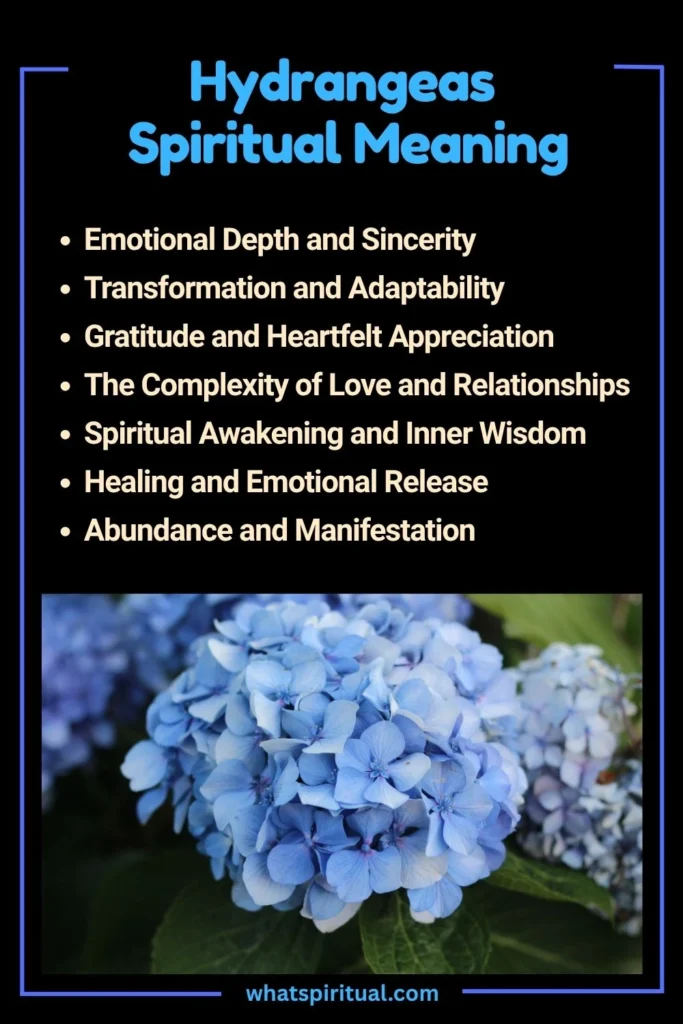
The hydrangea is a flowering plant native to Asia and the Americas. It belongs to the family Hydrangeaceae and includes over 75 species. The name comes from the Greek words hydor (water) and angos (vessel), meaning “water vessel.” This name reflects both the plant’s thirst for water and the cup-like shape of its seed capsules.
Hydrangeas bloom in large, dome-shaped or flat clusters. Each cluster holds dozens or even hundreds of small florets. This structure gives the flower its signature look of fullness, abundance, and wholeness. The plant thrives in temperate climates and blooms from spring through autumn.
One of the most striking features of the hydrangea is its color-changing ability. The pH level of the soil determines whether the flower appears blue, pink, or purple. Acidic soil produces blue blooms. Alkaline soil produces pink ones. This remarkable quality has made the hydrangea a natural symbol for transformation, sensitivity to environment, and the fluid nature of truth.
Hydrangeas are widely used in bouquets, garden design, and ceremonial spaces. Their massive flower heads make them visually impactful. Their spiritual symbolism makes them emotionally impactful. Both qualities together explain why so many people feel drawn to them without fully knowing why.
What Does Seeing a Hydrangea Symbolize?
When a hydrangea appears in your life, pay attention. Seeing a hydrangea is rarely accidental in the spiritual sense. It often arrives as a quiet signal from the universe, pointing you toward something you need to feel, accept, or release.
Seeing a hydrangea in full bloom typically symbolizes emotional abundance. Your heart is full, or it is asking to be filled. The flower’s clustered structure mirrors the idea that many small things working together create something magnificent. This is a message about community, connection, and the power of togetherness.
If the hydrangea you encounter looks wilted or faded, the spiritual message shifts. This signals a period of emotional exhaustion or transition. Something in your emotional world may be winding down. Rather than mourning that, the hydrangea invites you to trust the cycle. Plants that lose their blooms often grow stronger roots in the process.
Seeing a hydrangea when you are going through heartbreak, grief, or a major life change carries a specific spiritual resonance. The flower says: your feelings are valid, complex, and worth honoring. You do not need to rush past them. The hydrangea gives you permission to sit with your emotions and move through them with grace.
7 Spiritual Meanings of Hydrangeas
1. Emotional Depth and Sincerity
The hydrangea’s most prominent spiritual meaning is emotional depth. No other flower communicates the full weight of heartfelt feeling quite so completely. Its dense, layered blooms mirror the complexity of genuine emotion. Surface-level feelings do not produce a hydrangea. Depth does.
This flower has long been associated with sincerity and authenticity. When you give someone a hydrangea, you are saying something real. You are not offering a polished or curated version of your feelings. You are offering the whole truth of them, even the uncomfortable parts.
Spiritually, the hydrangea calls you to move beyond emotional performance. Many people have learned to display the emotions that are socially acceptable while suppressing the ones that are not. The hydrangea challenges that habit. It asks you to bring your full emotional self to the surface and trust that it is worth honoring.
Research in psychology consistently shows that emotional suppression leads to greater stress and worse health outcomes. Ancient traditions knew this long before modern science confirmed it. The hydrangea has always stood as a spiritual reminder: feel everything, suppress nothing, and trust the process.
2. Transformation and Adaptability
Few things in the natural world demonstrate transformation as visibly as the hydrangea does. Its color shifts based on its environment. What was once pink becomes blue when the soil changes. What was blue can return to pink. The flower does not resist this process. It simply adapts and continues to bloom.
This quality gives the hydrangea powerful spiritual resonance for anyone going through change. Whether you are navigating a career shift, a relationship ending, or a personal identity crisis, the hydrangea offers a message of graceful adaptability. You can change and still be beautiful. You can transform and still be whole.
The spiritual lesson here goes even deeper. The hydrangea does not try to be a fixed color. It does not fight its environment to remain the same. It cooperates with the conditions of its life and produces something stunning in the process. This is a profound spiritual model for how to navigate transformation in your own life.
Many spiritual traditions, including Buddhism and Taoism, emphasize the virtue of non-resistance. The hydrangea embodies this teaching perfectly. It accepts change as a natural part of existence and uses that change to express its full range of beauty. You are invited to do the same.
3. Gratitude and Heartfelt Appreciation
In the language of flowers, known as floriography, the hydrangea has long represented gratitude and heartfelt thanks. Victorian-era flower arrangers used hydrangeas to express appreciation that words could not adequately capture. The flower’s fullness suggested an overflowing sense of thankfulness.
Spiritually, gratitude is more than a social courtesy. It is a frequency. When you operate from genuine gratitude, you align yourself with abundance, grace, and spiritual openness. The hydrangea, as a symbol of this frequency, serves as a visual reminder to return to that state of appreciation.
The hydrangea also connects to gratitude as a spiritual practice rather than just a feeling. Gratitude requires effort, especially during difficult seasons. Noticing a hydrangea in those moments can serve as a spiritual anchor, pulling you back into awareness of what is still present, still beautiful, still worth honoring.
Across multiple spiritual traditions, gratitude is considered a gateway emotion. It opens the heart. It elevates consciousness. The hydrangea, with its full and generous bloom, embodies that spirit of open-hearted appreciation in physical form. Encountering one is an invitation to practice gratitude more deliberately.
4. The Complexity of Love and Relationships
The hydrangea is a deeply relational flower. Its blooms are never solitary. Each flower head contains dozens of florets working together to create a unified whole. This structure makes the hydrangea a powerful symbol for the complexity and beauty of relationships.
Spiritually, the hydrangea teaches that love is not simple. Real love involves many layers: joy and frustration, devotion and conflict, closeness and space. The hydrangea honors all of these dimensions. It does not suggest that love should be easy. It suggests that love, in all its complexity, is still something magnificent.
In romantic contexts, the hydrangea carries messages of both deep affection and emotional honesty. It is not the flower of infatuation or fleeting attraction. It is the flower of the long haul, of the kind of love that has weathered something and grown stronger for it. Giving someone a hydrangea is an acknowledgment that your love for them runs deep and holds complexity.
The hydrangea also speaks to the spiritual value of community and connection. Just as each tiny floret contributes to the flower’s larger beauty, each person in a community or family contributes to something greater than themselves. The flower is a reminder that you belong to something larger, and that belonging matters deeply.
5. Spiritual Awakening and Inner Wisdom
The purple hydrangea, in particular, carries strong associations with spiritual awakening. Purple has long been the color of the third eye chakra, spiritual vision, and higher consciousness. A purple hydrangea appearing in your life often signals that your spiritual awareness is expanding.
More broadly, the hydrangea’s shifting nature connects to the idea of spiritual perception. Just as the flower’s color depends on how you look at its environment, spiritual truth often depends on the lens you use to perceive it. The hydrangea invites you to question your assumptions and look more deeply at your reality.
Many spiritual practitioners use hydrangeas in meditation and altar spaces specifically because of this association with inner wisdom. The flower’s layered structure mirrors the layers of the self: the surface self, the emotional self, and the deeper spiritual core. Sitting with a hydrangea can encourage you to move through those layers in quiet contemplation.
The hydrangea also reminds you that wisdom comes through feeling, not just thinking. In a culture that prizes rational thought above emotional intelligence, the hydrangea stands as a counterpoint. It says that your feelings carry information. Your emotional life is a spiritual resource. Learning to trust it is part of your awakening.
6. Healing and Emotional Release
The hydrangea has a long history in healing traditions across multiple cultures. Japanese herbalists used parts of the hydrangea plant medicinally for centuries. On a spiritual level, the flower represents the kind of healing that happens when you allow yourself to fully feel and then release what you have been carrying.
Emotional wounds often persist not because they are too large to heal, but because they never received acknowledgment. The hydrangea, as a symbol of emotional depth and sincerity, encourages you to acknowledge what hurts. This is the first step in any genuine healing process.
In spiritual healing work, hydrangeas are sometimes placed in healing spaces to encourage emotional catharsis. Their presence creates an environment of emotional safety, a space where feelings are welcome and nothing needs to be hidden or minimized. This is a powerful spiritual gift.
The hydrangea’s seasonal cycle also carries healing wisdom. The plant dies back in winter and re-emerges in spring. This rhythm mirrors the natural cycles of grief and renewal in human experience. Healing is not linear. It is seasonal, cyclical, and ultimately regenerative. The hydrangea knows this and lives it without resistance.
7. Abundance and Manifestation
The sheer visual abundance of the hydrangea makes it a powerful symbol for manifestation and spiritual abundance. Each bloom contains multitudes. What looks like one flower is actually dozens working together to create something larger and more beautiful than any single floret could manage alone.
Spiritually, this structure reflects the principle that abundance flows from alignment and cooperation rather than from individual effort alone. The hydrangea asks: where in your life are you trying to do everything alone? Where might you open yourself to receiving help, support, or grace from sources larger than yourself?
Many law of attraction practitioners and spiritual manifestation teachers use hydrangeas as altar flowers specifically because they embody the energy of overflow. Their massive blooms suggest that there is enough, that life can be generous, and that beauty does not need to be rationed or saved.
The hydrangea also connects abundance to gratitude and emotional openness. You cannot truly receive abundance while emotionally closed. The flower’s wide-open bloom models the posture of openness that allows abundance to flow in. It is a spiritual reminder to soften, open, and trust that what you need will come.
Hydrangea Spiritual Meaning and Significance Across Cultures and Religions
Japan
In Japan, the hydrangea carries one of its most culturally specific meanings: apology and sincere remorse. The flower’s association with this meaning likely developed because hydrangeas bloom abundantly and change color, suggesting the shifting and layered nature of genuine repentance.
Japanese legend tells of an emperor who sent hydrangeas to a young woman’s family to apologize for neglecting her. This story cemented the flower’s association with sincere apology and emotional humility. Even today, hydrangeas are sometimes given in contexts where a heartfelt apology is needed.
Japan also celebrates hydrangea festivals called ajisai matsuri during the rainy season, when the flowers bloom most vigorously. These festivals honor the flower’s beauty and its deep connection to the rain, emotion, and the fullness of feeling. Temples and gardens across Japan fill with pilgrims who come simply to sit with the blooms.
The hydrangea’s rainy-season association connects it to purification and emotional cleansing in Japanese spiritual thought. Rain cleanses the earth. The hydrangea, thriving in that cleansing rain, becomes a symbol of the soul being washed clean of what it no longer needs.
Victorian England
Victorian culture developed an entire language around flowers, called floriography, and hydrangeas occupied a complex position within it. The flower simultaneously represented heartfelt emotion, gratitude, and vanity. This duality reflects the Victorian tension between emotional depth and social propriety.
Hydrangeas were used in elaborate floral arrangements for weddings, funerals, and formal social gatherings. Their size and fullness made them visually dominant, but their shifting colors made them emotionally complex. Victorians understood that a hydrangea arrangement carried layered meaning that a simpler flower could not.
The vanity association came partly from the hydrangea’s showy appearance and partly from its tendency to produce many blooms but relatively few seeds. In Victorian symbolic thinking, this suggested an excess of feeling without sufficient substance underneath. However, this interpretation has faded significantly in modern spiritual traditions.
What persisted from the Victorian tradition is the idea that hydrangeas speak to the full range and weight of human emotion. They are not light flowers. They carry something real. This understanding has shaped how the hydrangea is used in spiritual and ceremonial contexts even today.
China
In Chinese culture, hydrangeas carry associations with unity, togetherness, and the harmony of family. The clustered blooms represent family members gathered together, each individual contributing to a unified whole. Giving hydrangeas in China often expresses a wish for family unity and lasting togetherness.
The hydrangea also connects to yin energy in Chinese spiritual philosophy. Its round, soft form, its dependence on water, and its association with emotion all align it with the yin principle of receptivity, intuition, and inner depth. The flower encourages you to honor and cultivate your receptive, inner life.
In Chinese medicine and spiritual tradition, the hydrangea plant itself has been used to support kidney health, and the kidneys in Chinese medicine are associated with fear, willpower, and ancestral energy. The hydrangea’s spiritual resonance thus extends into the body, connecting emotional healing with physical vitality.
United States
In American cultural and spiritual life, hydrangeas carry strong associations with the Southern garden tradition, where they represent gracious hospitality, abundance, and welcome. A home with hydrangeas planted at the entrance signals that guests are warmly received and that the household values generosity.
Modern American New Age and spiritual communities have adopted the hydrangea as a symbol of emotional intelligence and spiritual sensitivity. Its color-changing quality appeals to communities that value personal growth, self-awareness, and the acceptance of complexity. The hydrangea fits naturally into the vocabulary of modern spiritual practice.
Hydrangea Symbolism in Mythology
While hydrangeas do not feature as prominently in ancient mythology as roses or lotus flowers do, they carry meaningful associations in the mythologies of the cultures where they grow natively.
In Japanese folklore, the hydrangea is associated with the story of the rain goddess and her tears. According to some regional traditions, hydrangeas grew from the place where the goddess’s tears fell during a season of great mourning. This origin story connects the flower permanently to sacred grief, divine emotion, and the beauty that can emerge from sorrow.
Some Japanese traditions also associate the hydrangea with the underworld and spirits of the ancestors. Hydrangeas planted near temples were thought to ease the transition between the living world and the spirit world. Their presence was believed to offer comfort to both the living and the departed.
In certain Native American traditions of the Eastern United States, where native hydrangea species grow, the plant carried spiritual significance related to the water element and purification. The plant’s deep thirst for water connected it to rivers, rains, and the cleansing power of water in ceremony and prayer.
Greek mythology, while not featuring hydrangeas directly, contains stories that resonate with the flower’s spiritual qualities. The myth of Narcissus, who became so absorbed in his own reflection that he withered away, finds a counterpoint in the hydrangea’s message of genuine emotional engagement over self-absorption. The hydrangea invites connection outward, not obsession inward.
Hydrangea as a Totem, Spirit Animal, and Power Animal
Hydrangea as a Totem
If the hydrangea is your totem, you are someone who feels everything deeply. You do not experience emotions at the surface level. You carry the full weight of your inner world, and you have likely been told at some point that you are “too sensitive.” But sensitivity, as the hydrangea teaches, is not a weakness. It is a form of spiritual intelligence.
People with the hydrangea totem are natural emotional healers. Others gravitate toward you when they need to feel understood. Your presence creates emotional safety without you necessarily saying anything. This is a rare and powerful gift, and it comes directly from your willingness to engage with emotional depth rather than avoid it.
The hydrangea totem also brings the gift of adaptability. Like the flower that changes color with its soil, you can shift your approach based on your environment. You read rooms naturally. You sense the emotional weather around you and adjust accordingly. This makes you a powerful communicator and an effective peacemaker.
Your challenge as a hydrangea totem person is boundaries. Because you feel so much and absorb so readily, you can become emotionally depleted when you do not protect your energy. The hydrangea plant itself needs abundant water to thrive, but it cannot function when waterlogged. This is your spiritual lesson: receive nourishment, but do not drown in the emotions of others.
Hydrangea as a Spirit Animal
When the hydrangea appears as your spirit animal, it comes as a guide specifically during times of emotional upheaval or transition. It shows up when you are processing grief, navigating a major change, or standing at a crossroads in your emotional life. Its appearance is a signal that you are not alone in what you are feeling.
The hydrangea spirit guide carries a particular message for people who intellectualize their emotions. You may be someone who analyzes feelings rather than experiencing them. The hydrangea spirit comes to remind you that feeling is not the opposite of wisdom. It is wisdom in its most direct form.
As a spirit guide, the hydrangea also helps you honor the past without being imprisoned by it. The flower blooms season after season from the same root system. It carries its history in its roots while consistently producing new beauty. This is the spirit guide’s central teaching: your past informs you, but it does not define your current bloom.
Hydrangea as a Power Animal
Call on the hydrangea as your power animal when you need to communicate something emotionally complex. Whether you are preparing for a difficult conversation, writing something deeply personal, or trying to express grief or love that feels too large for ordinary words, the hydrangea’s power amplifies your emotional clarity and your ability to express truth.
The hydrangea power animal also supports you when you are navigating group dynamics. Because the flower is made of many smaller blooms working together, it carries power around collective harmony and the resolution of conflict within groups or families. Call on this energy when community tension needs to be addressed with grace and emotional intelligence.
Hydrangea Color Meanings and Their Spiritual Significance
Blue Hydrangea Spiritual Meaning
Blue hydrangeas carry the deepest associations with devotion, emotional sincerity, and spiritual depth. Blue is the color of the throat chakra, which governs communication, and the third eye chakra, which governs intuition and inner vision. A blue hydrangea thus combines the energy of honest expression and spiritual perception.
Blue hydrangeas are also associated with calm and emotional stability. If you find yourself drawn to blue hydrangeas, it may signal that your spirit is seeking peace and clarity after a period of emotional turbulence. The flower offers the soothing energy of still water.
Pink Hydrangea Spiritual Meaning
Pink hydrangeas carry the energy of love, romance, heartfelt emotion, and warm affection. Pink is associated with the heart chakra, and pink hydrangeas channel heart chakra energy in its most abundant form. Their large, generous blooms suggest a love that is freely given and openly expressed.
Pink hydrangeas are the traditional choice for weddings and anniversaries because they carry the message that love is not small, conditional, or guarded. Real love, like the pink hydrangea, blooms in full view with no apology.
White Hydrangea Spiritual Meaning
White hydrangeas carry powerful associations with purity, spiritual clarity, new beginnings, and grace. White is the color of spiritual cleanliness, of the slate wiped clean, of the soul prepared for something new. White hydrangeas are frequently used in funeral and memorial arrangements because they honor the purity of the departed soul and the grace of spiritual transition.
White hydrangeas also appear in wedding arrangements as symbols of the purity and sincerity of the commitment being made. They signal that what is happening is real, sacred, and worthy of reverence.
Purple Hydrangea Spiritual Meaning
Purple hydrangeas are among the most spiritually charged of all the varieties. Purple connects directly to the crown chakra, the energy center associated with divine connection, spiritual awakening, and higher consciousness. A purple hydrangea in your life often signals that your spiritual awareness is being called to expand.
Purple hydrangeas are ideal for meditation spaces, spiritual altars, and healing environments. Their presence invites the energy of spiritual depth and encourages you to look beyond the surface of things. They are the flowers of spiritual seekers, mystics, and those who feel called to deeper wisdom.
Green Hydrangea Spiritual Meaning
Green hydrangeas are rarer but spiritually significant. Green connects to the heart chakra and to the energy of growth, renewal, and fresh starts. A green hydrangea carries the message that new life is possible, even in places where things have been stagnant or difficult.
Green hydrangeas also connect to abundance and prosperity in a grounded, earth-based sense. They remind you that real abundance grows from healthy roots, patient cultivation, and trust in the natural timing of things.
Hydrangea Biblical Meaning and Spiritual Significance in Christianity
The hydrangea does not appear by name in the Bible, but its spiritual qualities align strongly with several biblical themes and teachings. Christian spiritual traditions have drawn meaningful connections between the hydrangea and core biblical values.
The hydrangea’s association with abundance and grace resonates with the biblical concept of grace as overflow, of blessings that exceed what is measured or deserved. John 10:10, in which Jesus speaks of life lived “to the full,” captures the spirit of the hydrangea’s generous bloom. The flower embodies the theological idea that spiritual life is not meant to be small or stingy.
The hydrangea’s color-changing quality connects to the biblical theme of transformation and renewal. Romans 12:2 speaks of being “transformed by the renewing of your mind.” The hydrangea demonstrates this transformation visibly, changing its expression based on the conditions it grows in. It models the spiritual truth that growth requires responsiveness to your environment and a willingness to change.
White hydrangeas carry particularly strong biblical resonance. White throughout Scripture symbolizes holiness, purity, and the divine presence. Isaiah 1:18 speaks of sins made “white as snow.” Revelation describes the heavenly host dressed in white. A white hydrangea in Christian symbolic tradition represents spiritual purification and the grace of forgiveness.
The hydrangea’s structure, many small florets forming one unified bloom, reflects the New Testament metaphor of the body of Christ. 1 Corinthians 12 describes how many different members form one body, each contributing its unique function to a unified whole. The hydrangea lives this metaphor in botanical form, offering a natural image of unity, diversity, and interdependence.
Dreaming About Hydrangeas: Spiritual Meanings
Dreaming of Blooming Hydrangeas
If you dream of fully blooming hydrangeas, your subconscious is signaling emotional fullness and spiritual abundance. Something in your inner world is opening. You may be entering a period of greater emotional availability, deeper relationships, or personal flourishing. The dream is a positive sign of expansive energy moving through your life.
This dream often appears during periods of healing or spiritual growth. The full bloom represents the result of patient, invisible work happening beneath the surface. Trust what is emerging. The roots have been doing their work, and now the bloom appears.
Dreaming of Wilting or Dead Hydrangeas
A dream featuring wilted or dying hydrangeas typically signals emotional exhaustion, unresolved grief, or the end of a chapter. This is not a frightening dream. It is an honest one. Something in your emotional world has run its course. The dream is inviting you to acknowledge the ending and prepare for renewal.
Pay attention to which relationship or situation comes to mind when you wake from this dream. The hydrangea’s wilt is pointing you toward something that needs attention, completion, or release.
Dreaming of Changing Color Hydrangeas
If the hydrangeas in your dream shift or change color, your subconscious is processing a significant transformation in your identity, beliefs, or relationships. This dream often appears at major life crossroads. It signals that change is not only inevitable but also spiritually aligned. You are being prepared for a new expression of yourself.
Dreaming of Receiving Hydrangeas
Dreaming of someone giving you hydrangeas carries a message about your emotional relationships. It may signal that someone in your life wishes to offer you sincerity, gratitude, or a genuine apology. Alternatively, it may reflect your own desire to be truly seen and appreciated by someone you care about.
Pay attention to who gives you the flowers in the dream. The person’s identity usually carries specific meaning about the relationship that needs attention or healing in your waking life.
Dreaming of Planting Hydrangeas
A dream in which you plant hydrangeas signals intentional spiritual work. You are laying groundwork for something that will bloom later. This dream appears when you are beginning a new chapter: a new relationship, a creative project, a spiritual practice, or a healing journey. It tells you that you are planting wisely and that patience will be rewarded.
Summary Table: Hydrangea Spiritual Meaning at a Glance
| Aspect | Spiritual Meaning |
|---|---|
| General Symbolism | Emotional depth, heartfelt sincerity, abundance, transformation |
| Blue Hydrangea | Devotion, calm, honest communication, spiritual clarity |
| Pink Hydrangea | Romantic love, heart chakra energy, warm affection |
| White Hydrangea | Purity, grace, new beginnings, spiritual cleansing |
| Purple Hydrangea | Crown chakra, spiritual awakening, higher consciousness |
| Green Hydrangea | Growth, renewal, fresh starts, grounded abundance |
| Japanese Culture | Sincere apology, humility, emotional purification |
| Victorian Culture | Heartfelt gratitude, emotional complexity, abundance |
| Chinese Culture | Family unity, yin energy, togetherness |
| Biblical Symbolism | Grace, transformation, purity, unity within diversity |
| As a Totem | Emotional intelligence, deep sensitivity, adaptability |
| As a Spirit Animal | Guidance through transition, emotional processing, healing |
| As a Power Animal | Emotional expression, group harmony, conflict resolution |
| Blooming Hydrangea Dream | Emotional fullness, spiritual abundance, flourishing |
| Wilting Hydrangea Dream | Ending, emotional exhaustion, call for renewal |
| Changing Color Dream | Identity transformation, major crossroads, spiritual evolution |
| Receiving Hydrangeas Dream | Desire to be seen, incoming sincerity or apology |
| Planting Hydrangeas Dream | New beginnings, intentional spiritual work, patient growth |
A Final Note
The hydrangea’s spiritual message is one of the most human-centered in the plant kingdom. It does not ask you to be simple. It does not reward emotional avoidance or spiritual bypassing. It honors the full, complex, layered reality of what it means to feel deeply and live authentically.
Whether you encountered a hydrangea in your garden, in a dream, or on an altar, that meeting carries meaning. You are being invited to honor your emotional depth rather than manage it away. You are being asked to trust that transformation, even when uncomfortable, produces beauty. You are reminded that genuine connection, to yourself and to others, is one of the highest spiritual practices available to you.
Pay attention to the color of the hydrangeas you find yourself drawn to. Consider what is happening in your emotional and spiritual life right now. Think about which of the meanings in this post feel most alive and relevant to your current season. The hydrangea rarely arrives without purpose.
If you want to deepen your connection to this flower’s energy, consider growing hydrangeas in your garden, placing them on a meditation altar, or working with their imagery in journaling and reflection. Let the hydrangea teach you what it knows. What it knows is considerable.